
You Can't Secure What You Can't Measure: Why Modern Data Protection Needs Observability
Securelytix Team
Product & Security
23 July 2026
This article explores why protecting sensitive data isn't enough if you can't verify that protection is working. As modern applications span APIs, microservices, AI agents, and third-party services, organizations need observability to measure data protection in real time. Learn which security metrics matter, how observability reduces blind spots, and why continuous validation is becoming a core pillar of modern data security.
For years, organizations have invested heavily in protecting sensitive data. Encryption, access controls, firewalls, and identity management have become standard components of modern security architecture. Yet despite these investments, one critical question often goes unanswered:
How do you know your security controls are actually working?
Many organizations can confidently say they have deployed encryption or implemented tokenization. Far fewer can answer questions like:
- How many sensitive fields were protected today?
- Which types of PII are most frequently processed?
- Are applications consistently following data protection policies?
- Has sensitive data accidentally bypassed security controls?
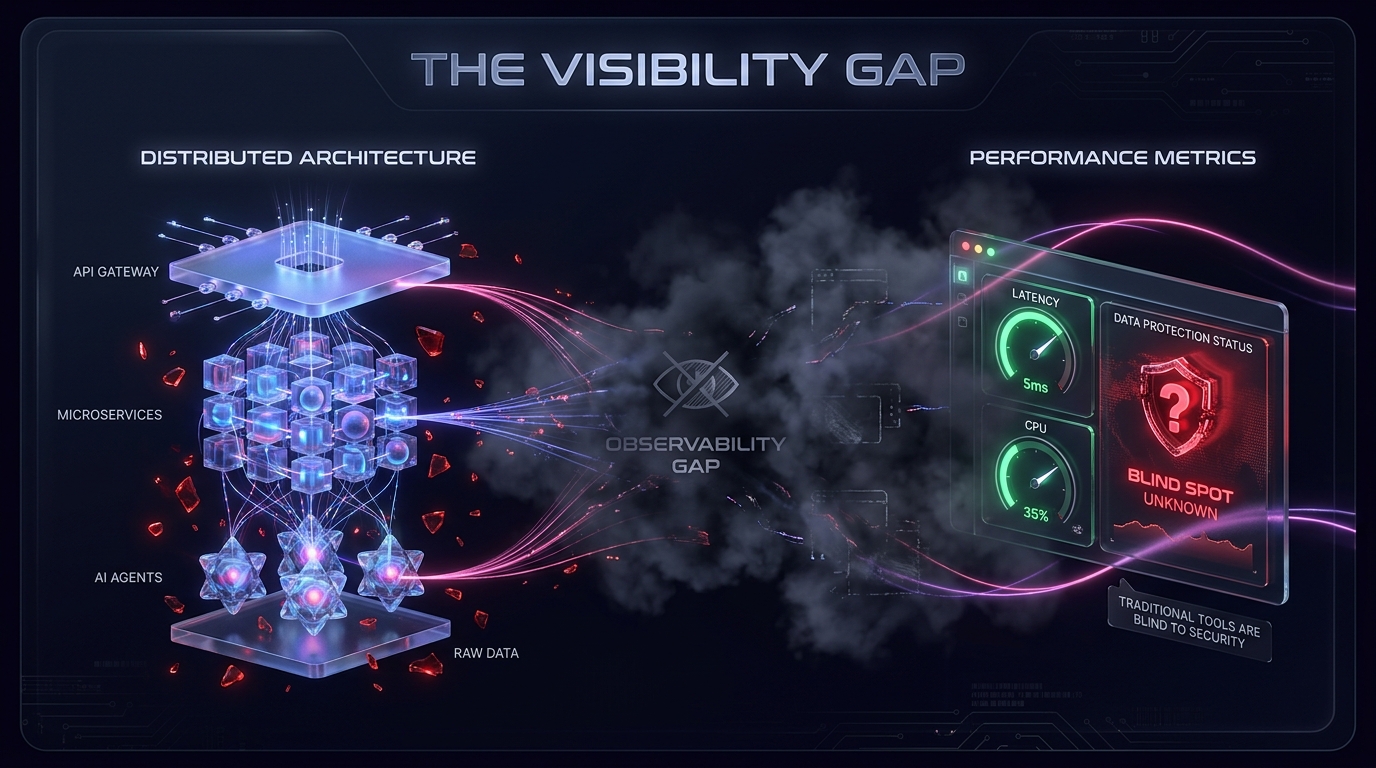
This visibility gap has become even more significant as applications evolve into distributed systems. A single customer request may travel through APIs, microservices, event streams, AI agents, logging platforms, analytics systems, and third-party services before the response is returned. Security controls may exist throughout the architecture, but without observability, teams have little evidence that those controls are functioning as intended.
Modern security is no longer just about preventing unauthorized access. It's about continuously validating that sensitive data is being handled correctly across every stage of its lifecycle. Data protection without visibility is simply an assumption and assumptions rarely hold up during audits, incident investigations, or production failures.
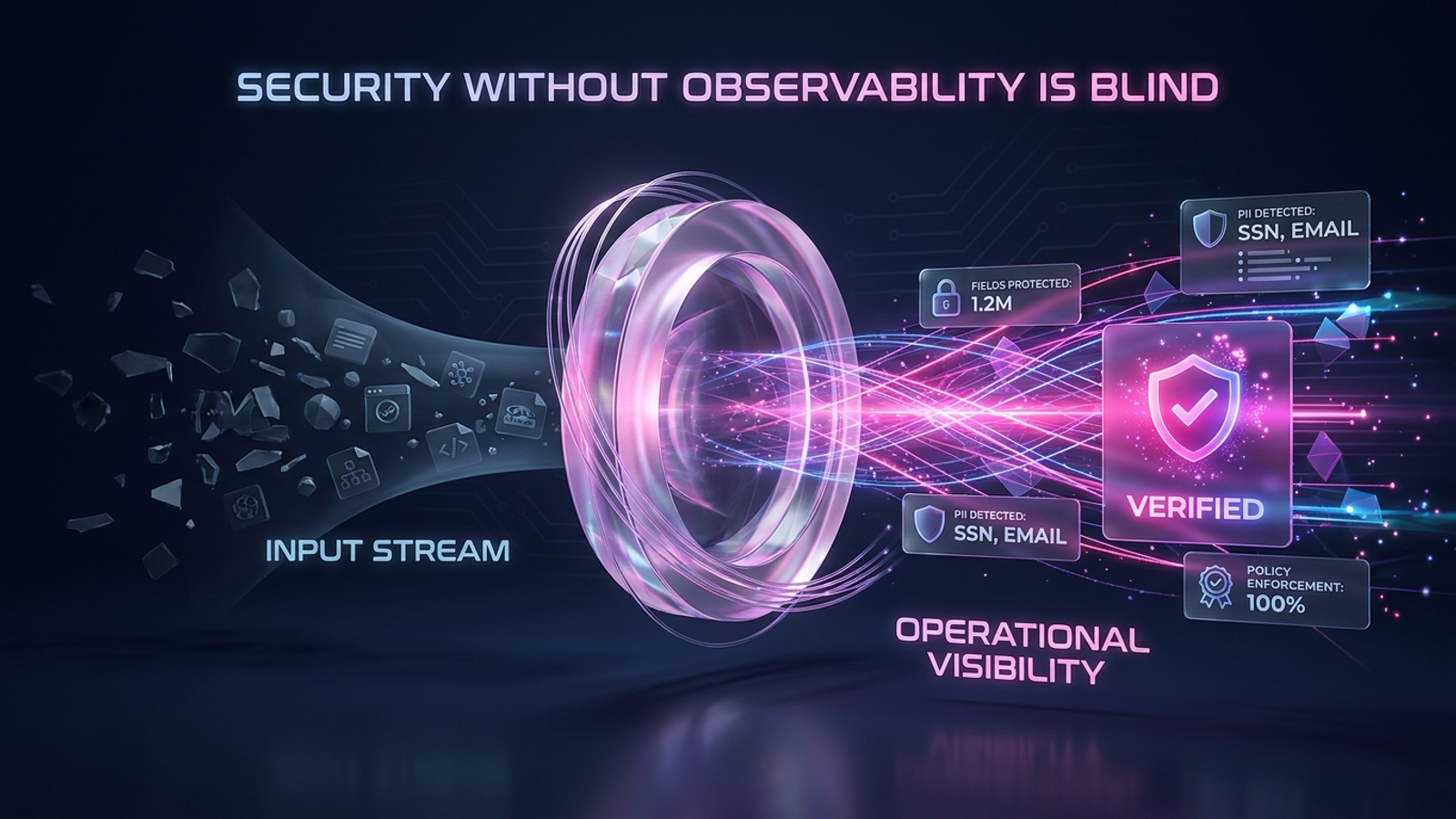
Security Without Observability Is Blind
Deploying a security control is only the first step. The bigger challenge is knowing whether that control is consistently doing its job in production.
Consider an application that tokenizes sensitive customer data before it's sent to downstream services. On paper, the architecture looks secure. But over time, APIs evolve, new microservices are introduced, developers add integrations, and AI-powered workflows become part of the request path. Unless every change is continuously validated, there's no guarantee that sensitive data is still following the intended protection flow.
This is where observability becomes essential.
In modern software engineering, observability helps teams answer questions about the health and behavior of their systems. The same principle applies to data security. Instead of only monitoring CPU utilization or API latency, organizations should also observe how sensitive data moves through their architecture.
For example:
- How many requests contained sensitive data?
- How many individual fields were protected?
- What types of PII were detected most frequently?
- Which services requested access to original values?
- Were any policy violations detected during runtime?
These metrics transform security from a static configuration into an operational capability.
Without this visibility, organizations often discover security gaps only after an audit, compliance review, or data exposure incident. By then, it's no longer a question of whether security controls existed it becomes a question of whether they were ever working as expected.
Security isn't something you configure once and forget. Like every critical production system, it needs continuous measurement, verification, and operational visibility.
The Problem: Modern Architectures Create Invisible Security Risks
A decade ago, protecting sensitive data was relatively straightforward. Most applications followed a monolithic architecture where requests flowed through a limited number of services before reaching a database. Security teams had a clear understanding of where sensitive information was stored and who had access to it.
Modern architectures are fundamentally different.
Today's applications are built on distributed systems where a single request may traverse multiple layers before it reaches its destination:
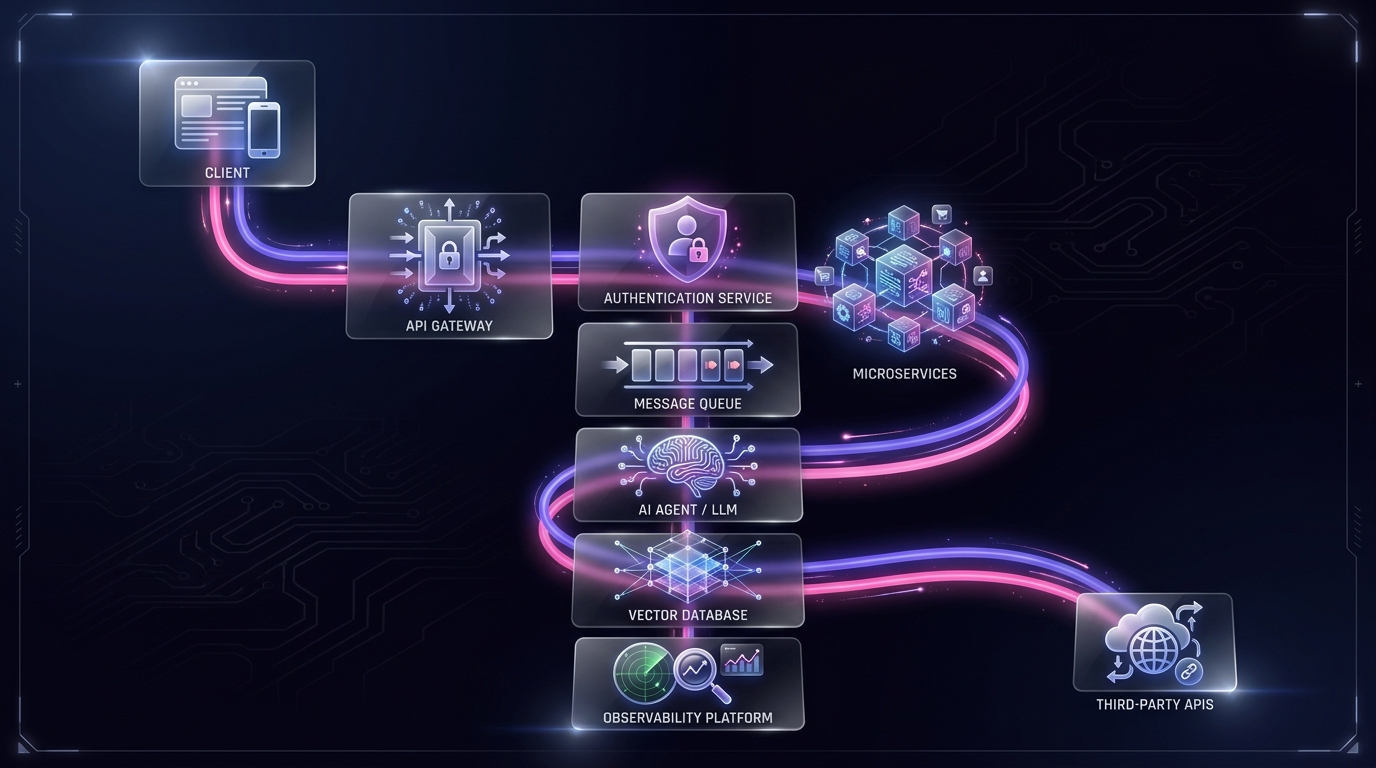
At every stage, there's a possibility that sensitive information is copied, cached, logged, or transmitted to another system. What begins as a single customer request can quickly become multiple instances of the same data spread across different components.
This creates what security architects refer to as an expanding trust boundary.
Instead of protecting one database, organizations are now responsible for securing every service that processes sensitive information. A vulnerability in any one of these components can expose data that was never intended to reside there.
The challenge becomes even greater with AI-driven applications. AI agents often orchestrate workflows across multiple tools, retrieve information from knowledge bases, invoke external APIs, and generate responses in real time. Without strict controls, sensitive data can unintentionally flow into prompts, vector databases, application logs, or third-party AI services extending the attack surface well beyond the original application.
Traditional security controls weren't designed for this level of data movement.
That's why modern security architecture is shifting from simply protecting infrastructure to protecting the data itself. Instead of assuming every service can safely handle raw sensitive information, organizations are adopting architectures that minimize where sensitive data exists, reduce unnecessary replication, and ensure access is governed by policy rather than trust.
The fewer systems that ever see sensitive data, the smaller the attack surface becomes and the easier it is to maintain security, compliance, and operational confidence as applications continue to evolve.
Why Traditional Security Metrics Fall Short
Organizations monitor hundreds of operational metrics every day. API response times, request throughput, CPU utilization, memory consumption, error rates, and infrastructure health are all essential for maintaining reliable systems.
But none of these metrics answer a much more important security question:
Is sensitive data actually being protected?
This is where traditional observability falls short.
Imagine an application processes one million API requests in a day. Engineering dashboards can tell you how many requests succeeded, how long they took, and whether any services experienced failures. What they can't tell you is:
- How many of those requests contained sensitive data?
- How many PII or PHI fields were identified and protected?
- Which categories of data emails, phone numbers, payment information, or government IDs were most frequently processed?
- Were any requests forwarded without applying the required protection policies?
- Did any service access original values outside approved workflows?
These are data protection metrics, and they rarely exist in conventional monitoring platforms.
Another common mistake is treating request volume as a measure of security. A single API request can contain dozens of sensitive fields, while another may contain none. Measuring only request counts provides little insight into the actual amount of sensitive data being processed. Effective security observability requires visibility into both requests and fields, because the volume of sensitive information is often very different from the volume of application traffic.
Similarly, knowing that encryption is enabled or that a tokenization service is running doesn't prove sensitive data is consistently protected. Security controls can be bypassed by configuration changes, newly deployed services, integration errors, or evolving application workflows. Without runtime measurements, these gaps often remain invisible until they're discovered during an audit or after an incident.
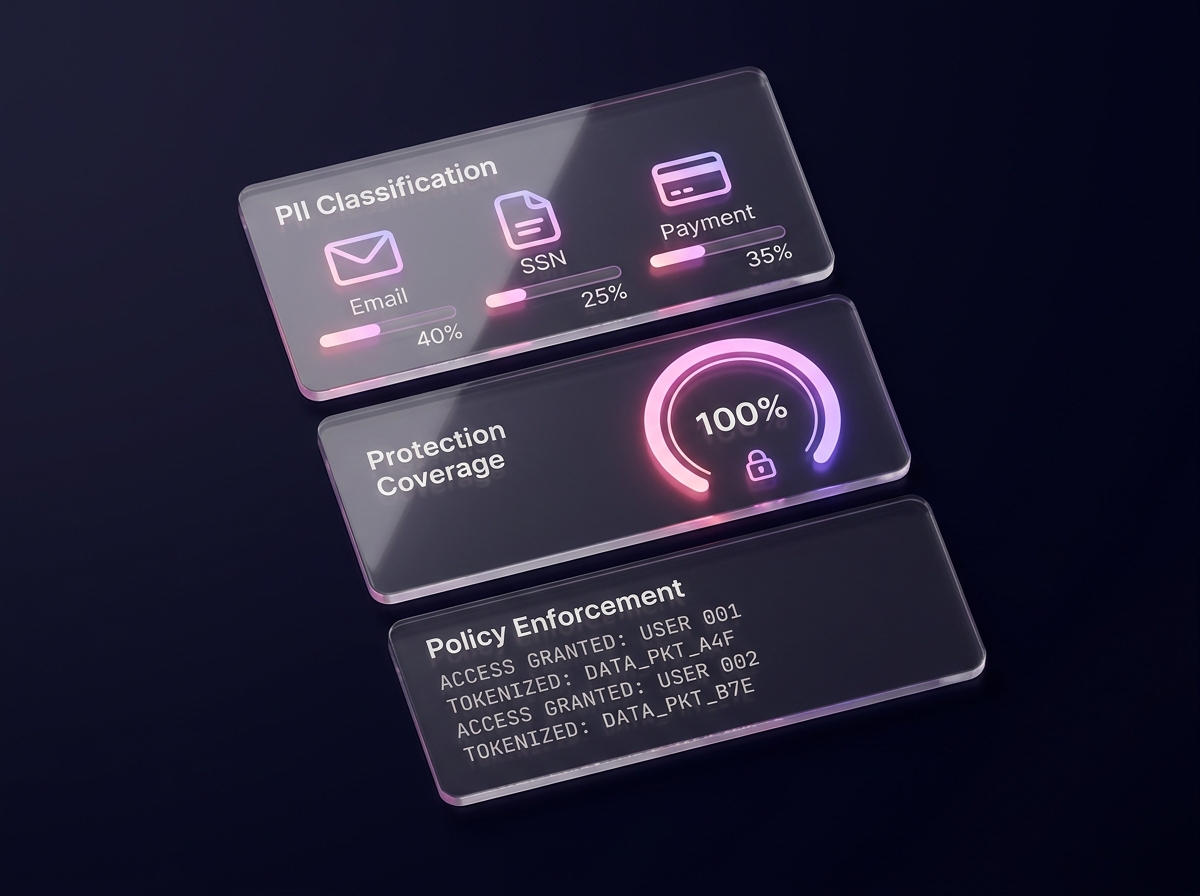
Security should be measured with the same rigor as system reliability. Just as engineering teams monitor latency, availability, and error rates, they should also monitor protection coverage, policy enforcement, detection accuracy, and data access patterns. These metrics provide evidence that security controls are functioning as intended not just that they have been deployed.
Building Observability into Data Protection
Achieving true data protection isn't just about deploying a vault or implementing tokenization. It's about building an architecture where every protection event can be measured, verified, and audited.
This starts with treating data protection as an observable workflow rather than a background security process.
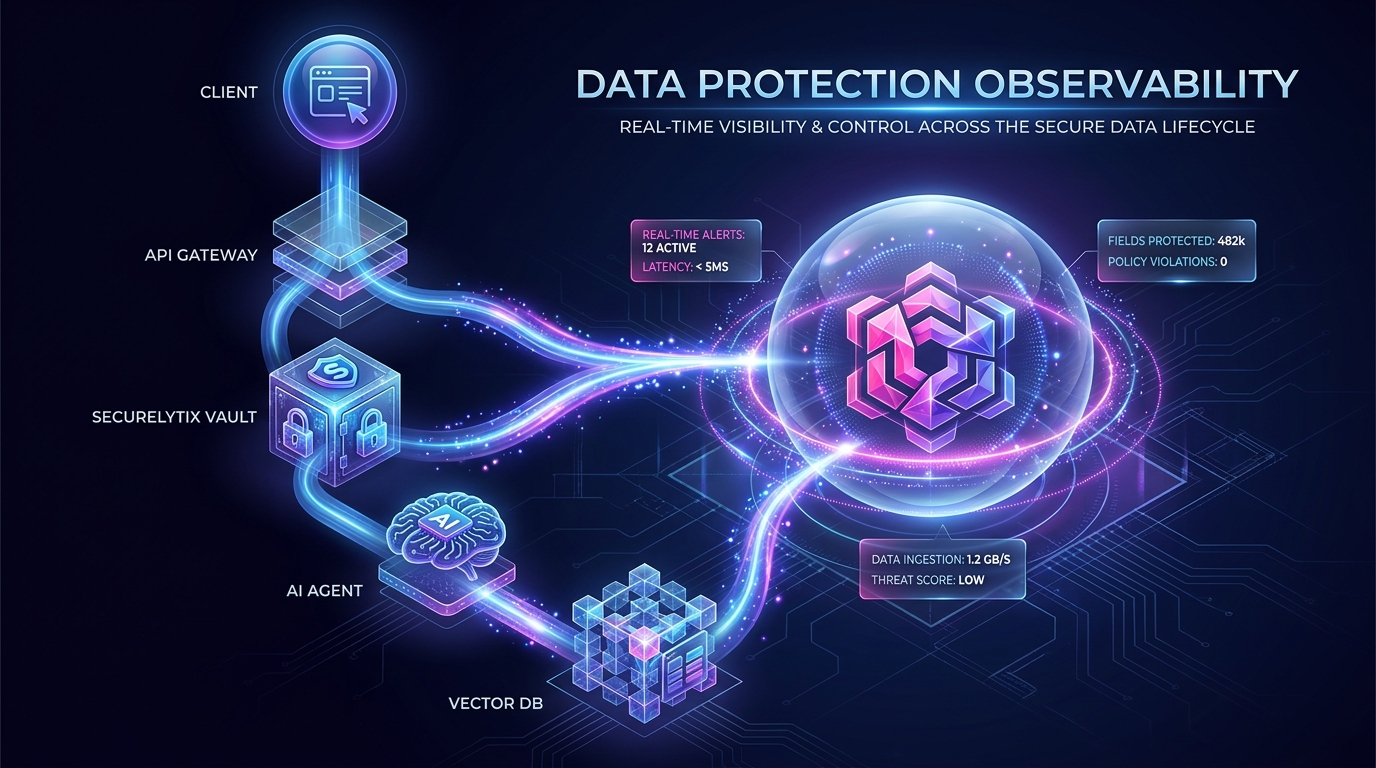
Whenever sensitive data is detected, a protection system should generate telemetry alongside the security operation. Instead of simply replacing a value with a token and moving on, the system should record operational metadata such as:
- What operation was performed (tokenize or detokenize)
- When the operation occurred
- How many sensitive fields were processed
- Which PII categories were detected
- Whether the operation succeeded or failed
- Which application or tenant initiated the request
Notice that none of this telemetry needs to expose the original sensitive values. The goal is to measure how data is being protected, not to create another repository of sensitive information.
These events can then be aggregated into meaningful security metrics. Engineering teams gain visibility into protection activity over time, identify unusual spikes in sensitive data processing, monitor policy compliance, and quickly detect services that deviate from expected behavior.
Another important principle is separating operational telemetry from business data. Security dashboards should present aggregated insights such as protection counts, PII breakdowns, or policy enforcement metrics without exposing the underlying customer information. This enables security teams to validate protection while maintaining privacy.
Observability also strengthens incident response. When a security event occurs, teams should be able to answer questions like:
- Which services processed sensitive data during the incident?
- Which data categories were involved?
- Was the data tokenized before leaving the application?
- Were any detokenization requests made outside approved policies?
- Which systems accessed the protected data?
Without this level of visibility, incident investigations rely heavily on assumptions and manual log analysis.
Ultimately, observability transforms data protection from a passive security control into an active engineering capability. Instead of hoping security policies are being followed, organizations can continuously validate them with measurable evidence, enabling faster troubleshooting, stronger compliance, and greater confidence in their security architecture.
What Engineering Teams Should Measure
Security observability is only valuable if teams track metrics that reflect how sensitive data is actually being protected—not just how applications are performing.
Some of the most important metrics include:
- Protection Coverage: How much sensitive data is successfully tokenized before reaching downstream systems?
- Sensitive Field Volume: Track protected fields instead of relying only on API request counts. One request can contain multiple sensitive values.
- PII Classification: Monitor the types of sensitive data being processed, such as emails, phone numbers, payment details, or healthcare records, to understand risk and compliance exposure.
- Runtime Access Patterns: Measure who requests detokenization, when it's performed, and whether access complies with defined security policies.
- Policy Violations: Identify requests that bypass protection, fail policy validation, or attempt unauthorized access to sensitive data.
- Operational Health: Monitor the availability, latency, and success rate of the protection layer to ensure security controls remain reliable.
These metrics provide engineering and security teams with measurable evidence that data protection controls are functioning as intended. Instead of assuming sensitive data is secure, organizations can continuously validate their security posture through observable, actionable insights.
Conclusion
Modern security isn't just about protecting sensitive data it's about proving that protection is working.
By combining data protection with observability, organizations gain continuous visibility into how sensitive data flows, how security policies are enforced, and where potential gaps exist. Instead of relying on assumptions, engineering teams can validate their security posture with measurable evidence.
As distributed systems continue to evolve, observability will become a core pillar of data security, enabling organizations to build architectures that are not only secure but also transparent, auditable, and resilient.
Frequently Asked Questions
What is security observability in data protection?
Security observability is the ability to continuously monitor, measure, and verify how sensitive data is protected as it moves through applications, APIs, AI systems, and distributed infrastructure. It provides evidence that security controls are functioning as intended rather than assuming they are.
Why are traditional monitoring metrics not enough for data security?
Traditional metrics like API latency, request volume, and CPU usage measure application performance but don't reveal whether sensitive data was detected, protected, or exposed. Security observability introduces metrics such as protection coverage, PII classification, policy violations, and runtime access patterns.
Which data protection metrics should engineering teams track?
Teams should monitor protection coverage, sensitive field volume, PII classification, runtime detokenization requests, policy violations, and the operational health of the protection layer. These metrics provide continuous visibility into the effectiveness of security controls and help maintain compliance.
Ready to Secure Sensitive Data?
Explore how Securelytix helps teams protect sensitive data, enforce privacy controls, and build Secure AI deployment.