
The Hidden Journey of Sensitive Data Inside AI Applications (And Why Most Teams Don't See It)
Securelytix Team
Product & Security
8 July 2026
AI has transformed how sensitive data flows through modern applications. Instead of moving only between users and databases, information now travels through prompts, LLMs, vector databases, agent memory, logs, and third-party services. This article explores why traditional security controls are no longer enough and how organizations can build privacy directly into AI workflows to minimize unnecessary data exposure.
For years, protecting sensitive data was relatively straightforward.
You encrypted databases, restricted access with IAM and RBAC, enabled audit logs, and made sure data was encrypted in transit. As long as only the right people and services could access it, you were in good shape.
AI applications have changed that assumption.
Today, data doesn't just move from a user to a database and back. It flows through prompt builders, LLMs, embedding models, vector databases, agent memory, orchestration frameworks, observability platforms, and sometimes multiple third-party APIs before a response ever reaches the user.
The challenge isn't simply who can access sensitive data anymore.
It's understanding where that data travels once your AI application starts reasoning over it.
It Starts With a Single Prompt
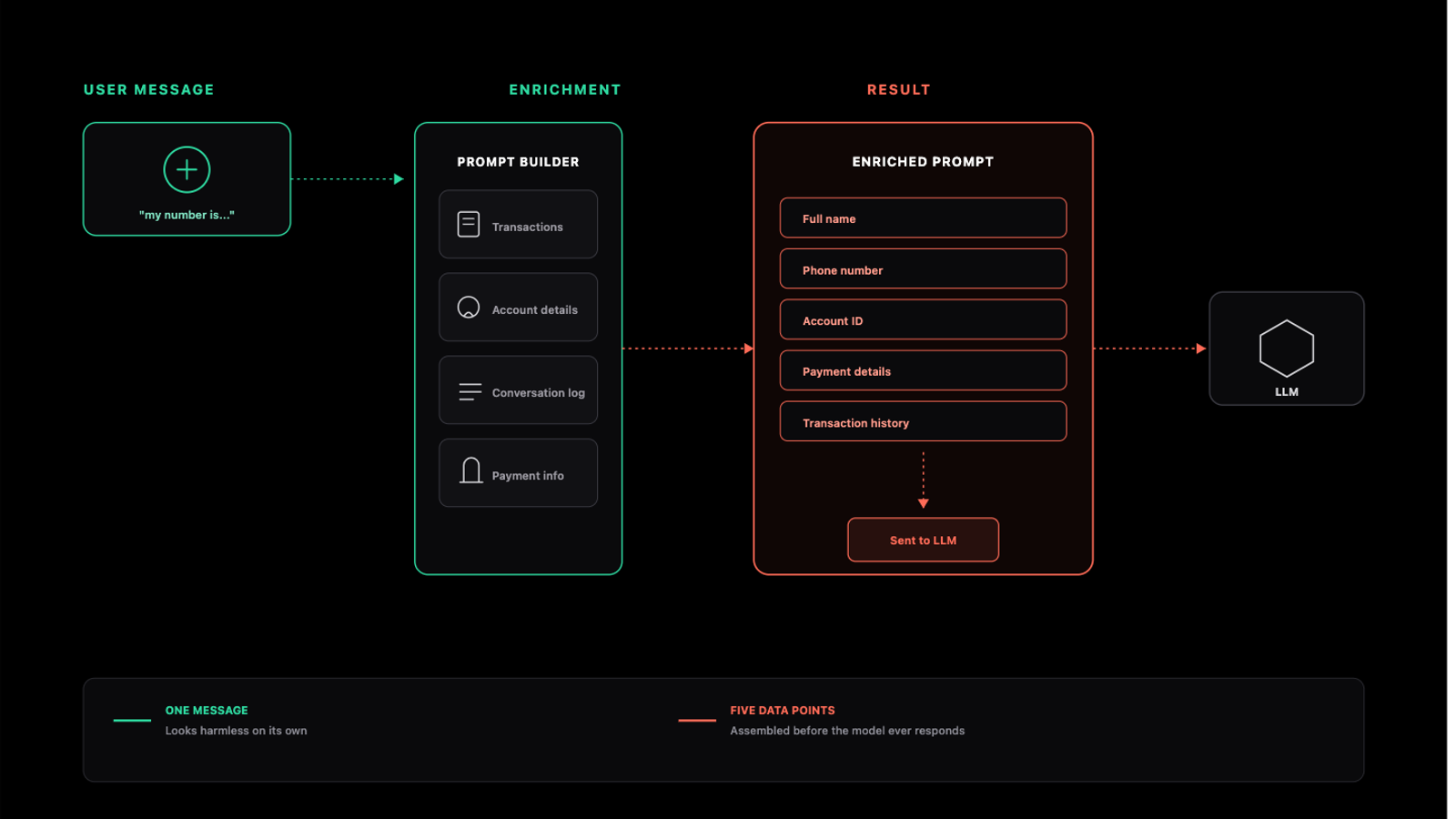
Imagine a customer opens a support chat and types:
"Hi, I'm ABC. My phone number is 9876543210, and I need help with my last transaction."
To the user, it's just a message.
To your AI application, it's much more than that.
The backend retrieves additional context, maybe recent transactions, account details, or previous conversations. A prompt template combines all of this into a single request before sending it to the LLM.
At this point, the prompt may contain names, phone numbers, email addresses, account IDs, payment information, or other personally identifiable information (PII).
Most engineering teams focus on whether this request is encrypted during transit which is important but that's only one part of the story.
Once the prompt reaches the AI pipeline, the data often begins to spread.
It may be copied into request logs for debugging. It might be captured by tracing and observability tools. If the application uses AI agents, the same context can be stored in memory so the agent can complete future tasks without asking the user again.
None of this is usually intentional.
It's simply how modern AI frameworks are designed to improve context, performance, and developer experience.
The problem is that every additional copy creates another place where sensitive data can persist long after the original request has been processed.
Data Propagation in AI Applications
Once a prompt reaches an LLM, the interaction rarely ends there.
In most production AI systems, the response is just one part of a larger workflow. Applications retrieve information from vector databases, invoke external tools, call internal APIs, execute business logic, and maintain context across multiple interactions. These capabilities make AI systems more useful, but they also increase the number of places where sensitive data can travel.
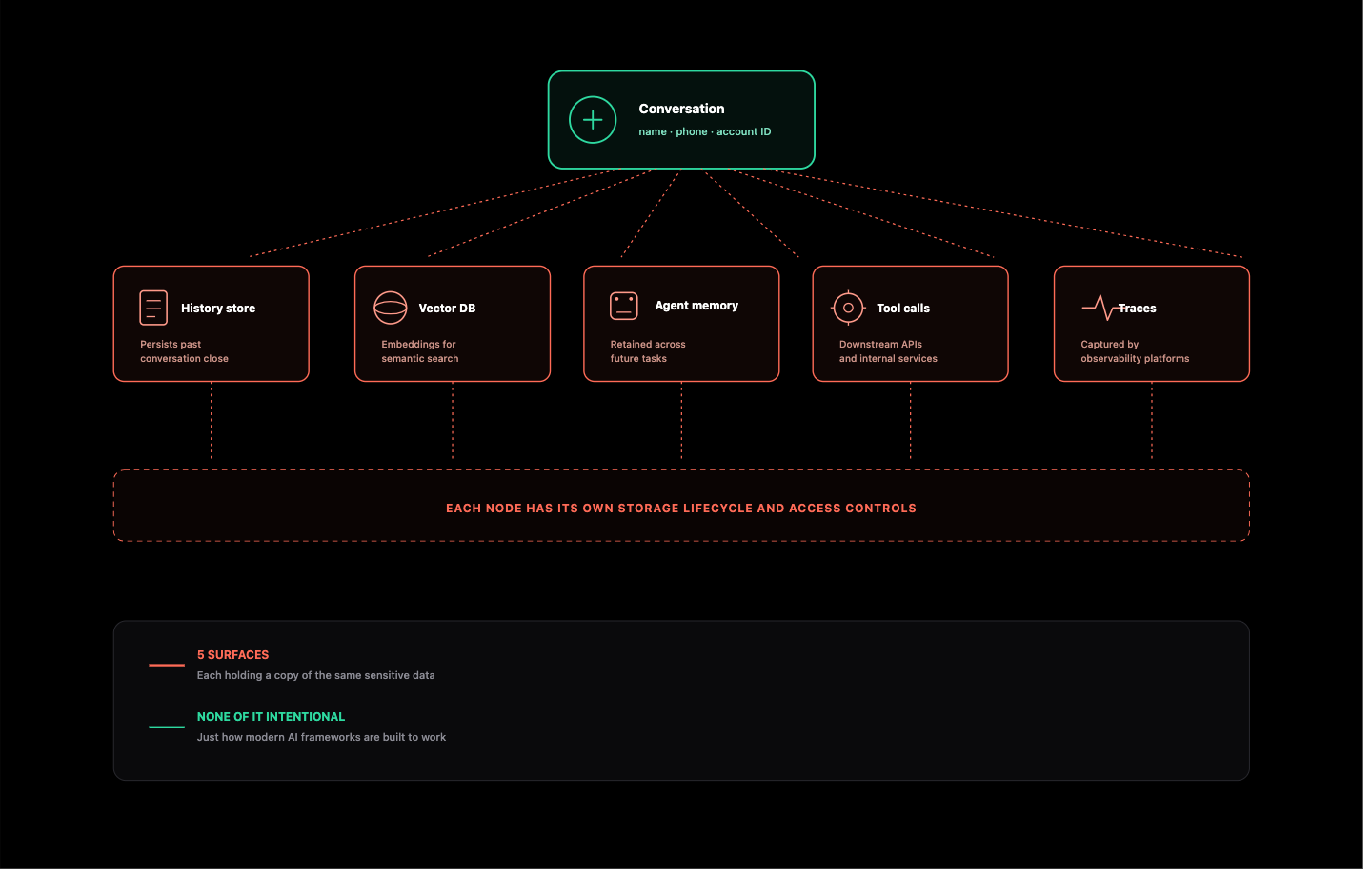
Consider a customer support agent that helps users with account-related requests. During a single conversation, the customer's name, email address, account ID, and transaction details may be used to construct the prompt, stored as conversation history, embedded for semantic search, passed to downstream services through tool calls, and captured in logs or traces for debugging.
None of these components are inherently insecure. In fact, each exists for a valid reason whether it's improving retrieval accuracy, maintaining conversational context, or helping developers troubleshoot production issues.
The challenge is that sensitive information often gets replicated across these systems as a byproduct of normal application behavior. What started as a single user request can end up existing in multiple locations, each with its own storage lifecycle, access controls, and retention policies.
This isn't unique to one framework or model. It's a characteristic of modern AI architectures, where intelligence is built by connecting multiple services that continuously exchange context and data.
As AI applications become more capable, understanding how information propagates across the stack becomes just as important as securing the systems themselves.
Why Traditional Security Controls Aren't Enough
Enterprise security has long been built around controlling access to data.
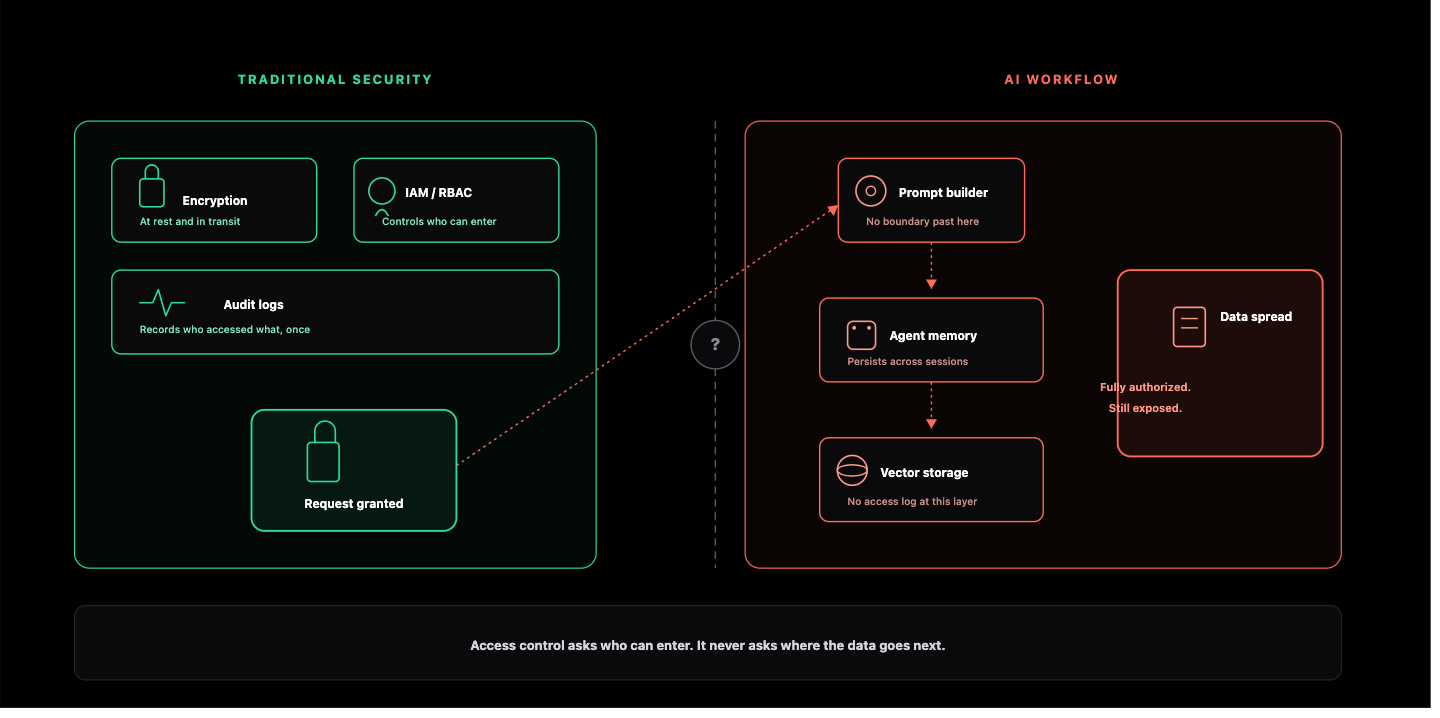
Encryption protects information at rest and in transit. IAM and RBAC determine who can access specific resources. Audit logs help organizations understand who accessed what and when. These controls remain essential, and they continue to play a critical role in securing modern applications.
However, AI introduces a different challenge.
Once an application is authorized to access sensitive data, that information can move through multiple AI components as part of a normal workflow. The prompt builder may enrich a request with customer context. An agent may retain information to complete future tasks. A vector database may store embeddings to improve retrieval. Observability platforms may capture traces to help engineers debug production issues.
From a security perspective, none of these actions are unauthorized. The application is doing exactly what it was designed to do.
The challenge is visibility and control over how sensitive data propagates after access has already been granted.
Traditional security answers the question, "Who should be allowed to access this data?"
AI applications introduce another equally important question:
"Once access is granted, how can we ensure sensitive data doesn't spread beyond where it's actually needed?"
As AI systems become more autonomous and interconnected, protecting sensitive information requires thinking beyond access controls. It requires limiting unnecessary exposure throughout the entire AI workflow.
Building Privacy Into AI Workflows
As AI applications become more sophisticated, privacy needs to become part of the application architecture rather than an afterthought.
A practical approach is to minimize the amount of sensitive data that enters the AI pipeline in the first place. Instead of allowing raw PII to flow through prompts, embeddings, agent memory, logs, and downstream services, applications should expose only the information that's necessary for the task at hand.
This follows a principle that security teams have applied for years: least privilege. For AI, the same idea extends to least data exposure.
If an AI agent only needs to identify a customer, it doesn't necessarily need access to their full phone number or payment details. If a support workflow requires a customer reference, it can often work with a tokenized identifier instead of the original sensitive value.
Designing systems this way reduces the number of places where sensitive information can be copied, stored, or retained. It also simplifies compliance by limiting the spread of regulated data across the AI stack.
The goal isn't to restrict what AI can do. It's to ensure that intelligence doesn't come at the cost of unnecessary data exposure.
Putting It Into Practice
This is the approach we've taken at Securelytix.
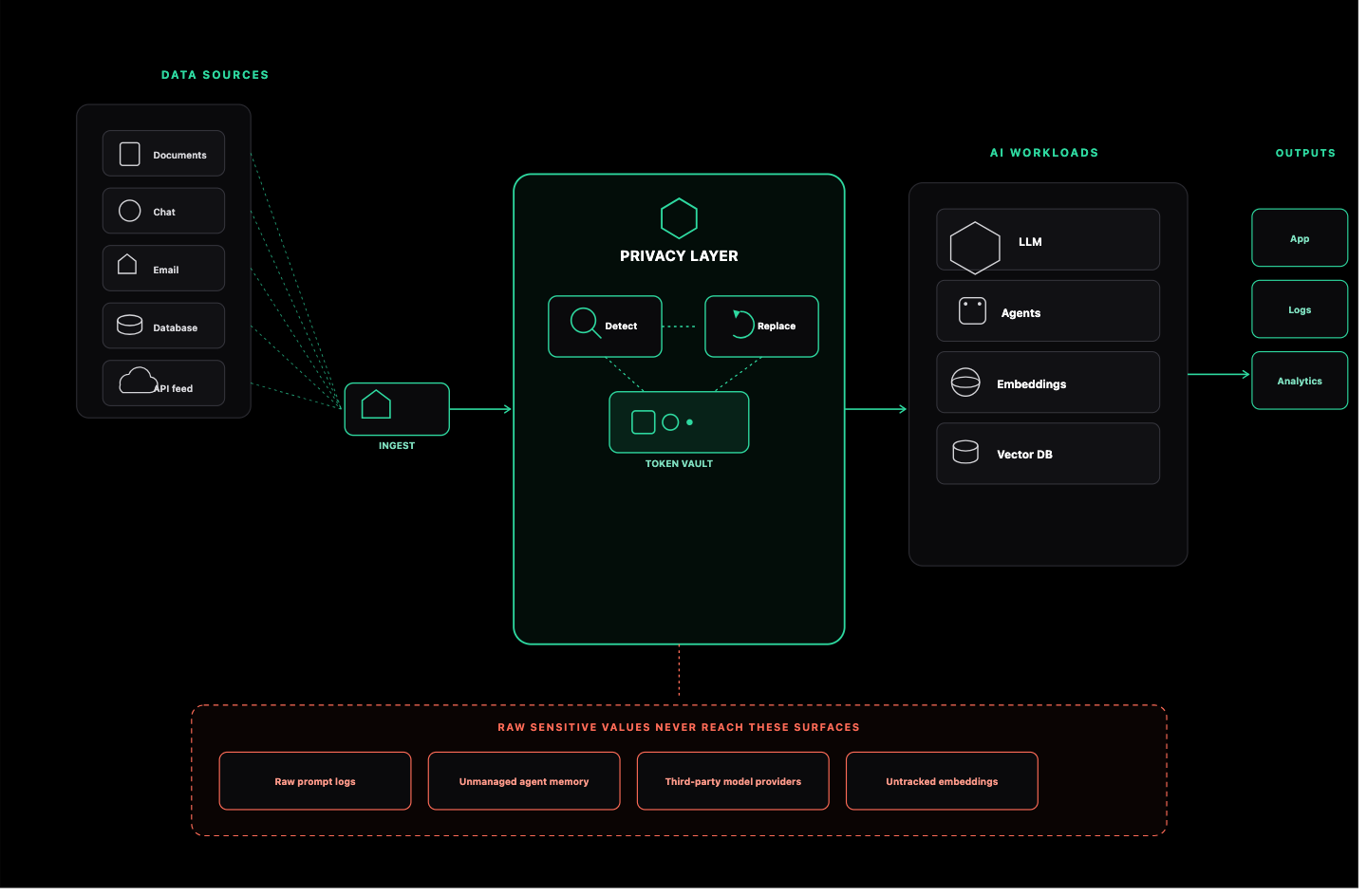
Rather than relying solely on access controls or post-processing, Securelytix adds a privacy layer between enterprise data and AI applications. As sensitive information enters the AI workflow, it is automatically tokenized and replaced with secure references before reaching prompts, LLMs, vector databases, agent memory, or application logs.
From the application's perspective, the workflow remains unchanged. AI agents can continue to retrieve context, reason over information, and execute tasks without directly handling raw sensitive values.
This approach helps organizations reduce the risk of exposing PII across the AI stack while allowing developers to build and ship AI-powered features without redesigning existing workflows.
As AI adoption continues to accelerate, protecting sensitive data can no longer be limited to databases or network boundaries. Privacy needs to travel with the data throughout its entire lifecycle from the moment it enters an application to every AI component that processes it.
Conclusion
AI applications have fundamentally changed how data moves through modern software. A single user request can pass through prompts, retrieval systems, agent memory, vector databases, logging platforms, and external services all within a matter of seconds.
Securing these systems isn't just about controlling access anymore. It's about understanding how sensitive information flows across the AI stack and designing applications that minimize unnecessary exposure at every step.
As organizations continue to build more capable AI systems, privacy should be treated as a core architectural principle, not an afterthought. The earlier it's built into the workflow, the easier it becomes to innovate with confidence while protecting the data users trust you with.
Frequently Asked Questions
Why is protecting sensitive data in AI applications more challenging than in traditional applications?
Traditional applications typically move data between users, APIs, and databases. AI applications, however, process data through multiple components such as prompt builders, LLMs, vector databases, agent memory, orchestration frameworks, and observability tools. As a result, sensitive information can be copied, cached, or stored in several places during normal operation, increasing the risk of unintended exposure.
What types of sensitive data can unintentionally spread across an AI pipeline?
AI applications often handle Personally Identifiable Information (PII), payment details, account numbers, customer records, healthcare information (PHI), business secrets, API keys, and other confidential enterprise data. Without proper controls, this information may appear in prompts, logs, embeddings, conversation history, vector databases, or third-party AI services.
Why aren't encryption and access controls enough for AI security?
Encryption, IAM, and Role-Based Access Control (RBAC) protect data at rest, in transit, and by controlling who can access it. However, once an AI application is authorized to use sensitive information, that data may continue flowing through multiple AI components as part of normal processing. Organizations also need controls that minimize unnecessary data exposure throughout the AI workflow, not just before access is granted.
How can organizations reduce sensitive data exposure in AI applications?
A privacy-by-design approach is the most effective strategy. Organizations should minimize the amount of sensitive information entering AI systems, tokenize or mask PII before it reaches prompts and models, enforce least-data-exposure principles, continuously monitor AI workflows, and maintain comprehensive audit trails. By embedding privacy into the architecture from the start, teams can build AI applications that are both powerful and secure.
Ready to Secure Sensitive Data?
Explore how Securelytix helps teams protect sensitive data, enforce privacy controls, and build Secure AI deployment.