
Stop Treating Vector Databases Like Databases: They Were Never Built to Store Sensitive Data
Securelytix Team
Product & Security
15 July 2026
Vector databases have become the backbone of enterprise AI, but they were never designed to store sensitive data. As RAG applications and AI agents grow, protecting prompts alone isn't enough. This article explores why privacy must begin before embeddings are created and how organizations can build secure, privacy-first AI architectures without sacrificing AI performance.

Stop Treating Vector Databases Like Databases: They Were Never Built to Store Sensitive Data
For years, databases were the primary place security teams worried about protecting sensitive information. If customer records contained names, phone numbers, payment details, or health information, the focus was clear: secure the database with encryption, access controls, monitoring, and audits.
Generative AI has quietly changed that architecture.
Today, enterprise data doesn't just live in transactional databases. It flows through document processors, embedding models, vector databases, retrieval pipelines, AI agents, prompt builders, observability tools, and LLMs. Every step in that pipeline creates another place where sensitive information can be stored, copied, or exposed.
One of the biggest shifts has been the adoption of vector databases. As Retrieval-Augmented Generation (RAG) becomes the foundation of enterprise AI, vector databases have become the default way to help models retrieve relevant context. They make AI applications more accurate, more useful, and capable of answering questions grounded in an organization's own knowledge.
But there's a misconception that often follows this architecture:
"We're only storing embeddings, not the original data, so privacy isn't really a concern."
It's an understandable assumption, but it's also an incomplete one.
Why Vector Databases Became the Default Knowledge Layer
Large language models are impressive, but they have one significant limitation: they don't know anything about your organization's data unless you provide it.
A model like GPT can explain a Kubernetes deployment or summarize a legal concept, but it has no built-in knowledge of your company's support tickets, internal documentation, customer contracts, engineering runbooks, or HR policies.
That's where Retrieval-Augmented Generation (RAG) comes in.
Instead of retraining an LLM every time information changes, organizations store their documents in a vector database. When a user asks a question, the application converts that query into an embedding, searches for semantically similar content, and sends the most relevant chunks to the model as context.
The result is an AI system that can answer questions using your organization's latest information without requiring expensive model fine-tuning.
At a high level, the flow looks like this:
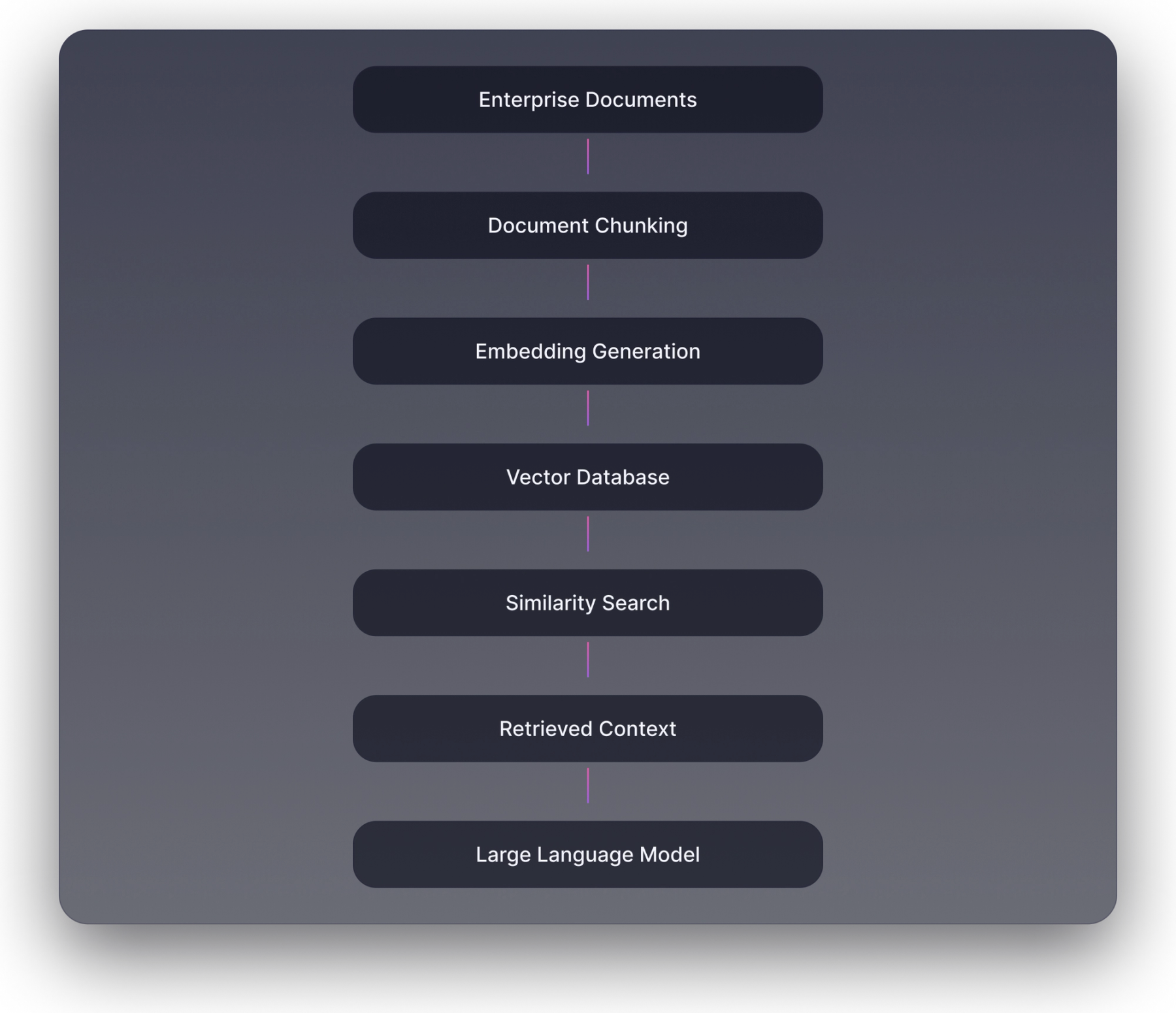
This architecture has become the foundation for enterprise AI. Whether it's an internal knowledge assistant, a customer support chatbot, a legal copilot, or an autonomous AI agent, chances are there's a vector database somewhere in the stack. And the data being indexed isn't trivial.
"It's Just Embeddings" Is a Dangerous Assumption
One of the most common arguments in discussions around AI security goes something like this:
"We're not storing the original documents in the vector database. We're only storing embeddings, so even if someone gains access, they can't read the underlying data."
There's some truth to that statement. An embedding is a numerical representation of text, not the text itself. You can't simply open a vector and read it like a PDF or a database row.
But that's also the wrong question to ask.
The goal of a vector database isn't to store embeddings in isolation. Its purpose is to retrieve the pieces of information those embeddings represent.
Every embedding is tied to a chunk of content—whether that's a paragraph from an employee handbook, a customer support conversation, a contract, or an internal engineering document. When a similarity search finds a relevant match, the application retrieves the associated text and includes it in the prompt sent to the LLM.
In practice, the flow looks something like this:
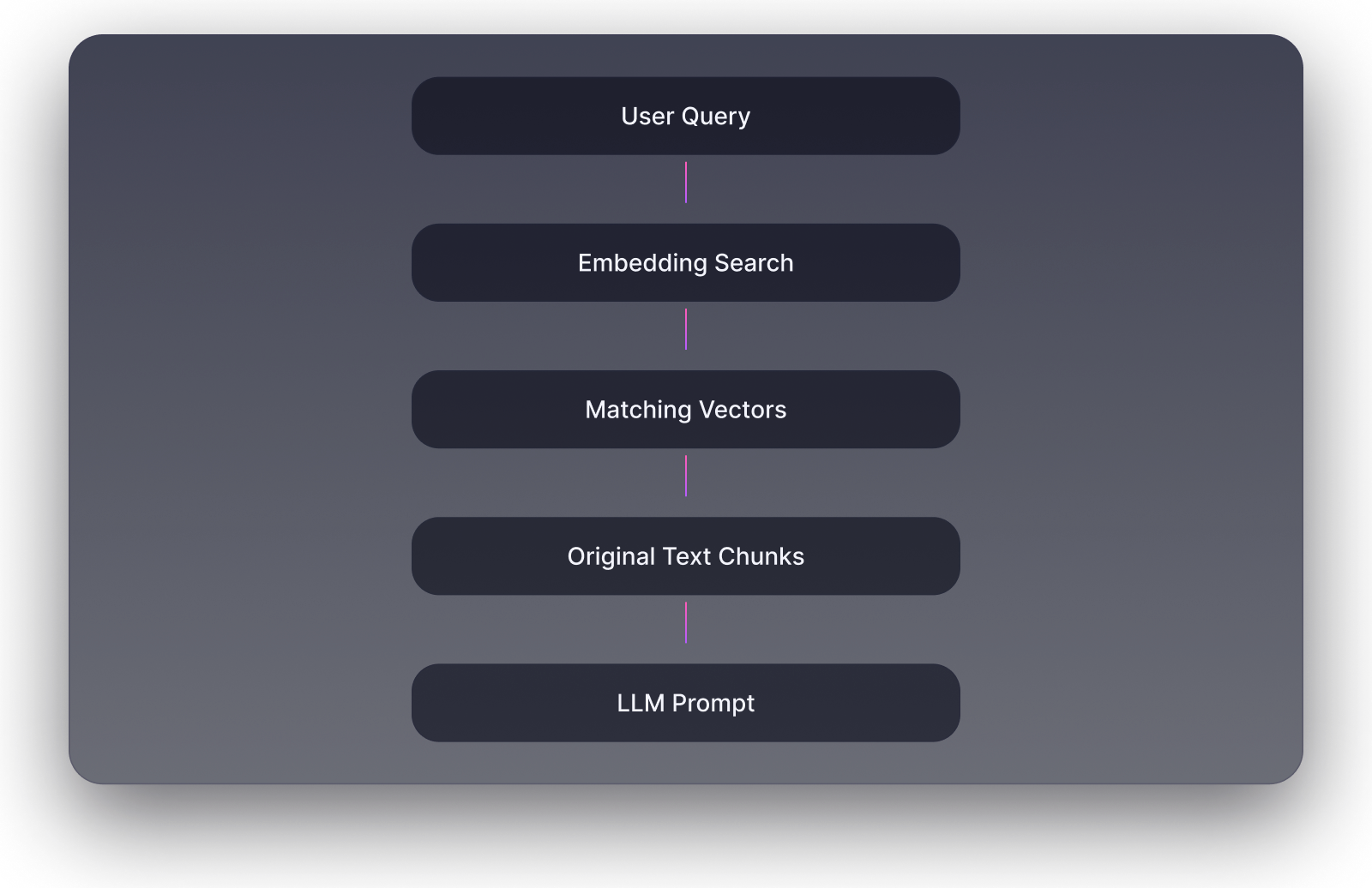
The embedding itself isn't what the model sees. The model sees the original content that was retrieved because of that embedding.
This is why focusing only on whether embeddings can be "reversed" misses the bigger picture.
The more important question is:
What information is the retrieval system allowed to return?
Imagine an internal AI assistant connected to a company's knowledge base.
An employee asks:
"Show me recent enterprise customers who reported payment issues."
A well-designed retrieval system might return sanitized summaries or role-appropriate information.
A poorly governed one could retrieve support tickets containing customer names, phone numbers, email addresses, payment references, or internal notes that were never meant to be exposed to that user. The model isn't doing anything malicious. It's simply answering based on the context it was given.
This is why retrieval has become one of the most important trust boundaries in modern AI architectures. The challenge grows as AI agents become more autonomous.
Privacy Has to Start Before Embeddings Are Created
Once a document has been chunked, embedded, indexed, and made available for retrieval, you've already expanded your AI data footprint.
By that stage, sensitive information may have passed through multiple systems:
- Document ingestion pipelines
- Embedding models
- Vector databases
- AI orchestration frameworks
- Prompt construction services
- Observability and tracing platforms
Even if you later redact prompts before they're sent to an LLM, you've only addressed one part of the pipeline. The data has already existed in several places before that final step.
That's why protecting AI applications isn't just about securing inference, it's about securing the entire data journey.
A more resilient approach is to identify and protect sensitive information before it enters the embedding pipeline.
Consider a customer support document like this:
Customer: ABC
Phone: +1234567
Email: abc@gmail.com
Issue: Credit card payment failed for order #458221.
If this document is embedded as-is, every downstream component works with content that contains personally identifiable information (PII).
Instead, the document can be transformed before embeddings are generated:
Customer: <CUSTOMER_ABC>
Phone: <PHONE_12345>
Email: <EMAIL_abc>
Issue: Credit card payment failed for order <ORDER_458221>.
The document still preserves its meaning. An AI assistant can identify that a customer experienced a payment issue, retrieve similar cases, or summarize trends without needing the customer's actual phone number or email address.
AI models are optimized for understanding context, not memorizing exact identifiers. Whether a support ticket contains ABC or <CUSTOMER_ABC>, the model can still reason effectively while reducing the amount of regulated data flowing through the AI pipeline.
This is the foundation of privacy-by-design for AI. Instead of treating data protection as a final filtering step, sensitive information is protected before it enters the embedding and retrieval pipeline, allowing downstream components to operate on sanitized data.
When access to the original value is genuinely required for example, to verify a customer's identity or update a CRM record . It should be authorized for that specific operation, governed by policy, and fully auditable.
This shifts the security model from protecting sensitive data after it spreads to preventing unnecessary exposure in the first place.
Building a Privacy-First RAG Architecture
As AI applications move from prototypes to production, the challenge is no longer just building them, it's operating them securely.
A RAG pipeline isn't a simple application integration. A single user query can trigger document retrieval, reasoning, API calls, and interactions with multiple services in seconds. Security, therefore, can't rely on a single checkpoint. It has to be built into the entire data flow.
Here are five principles for designing a privacy-first RAG architecture.
1. Discover sensitive data before ingestion
Before documents are chunked and embedded, identify sensitive information such as PII, PHI, financial records, credentials, or confidential business data. Visibility at this stage allows organizations to apply the right protection before the data enters the AI pipeline.
2. Minimize what the AI actually needs
AI models rarely need raw sensitive values to perform their task. In many cases, replacing identifiers with consistent references preserves the context needed for reasoning while reducing unnecessary exposure throughout the retrieval pipeline.
3. Govern retrieval, not just access
Traditional security asks, "Can this user access the data?" AI introduces a different question: "Should this information be retrieved for this request?"
Retrieval decisions should consider user context, data sensitivity, and the task being performed, not just whether a document exists in the vector database.
4. Control access at runtime
When an application genuinely needs the original sensitive value, access should be authorized only for that specific operation, governed by policy, and limited in scope. Sensitive data should not remain exposed throughout the AI workflow by default.
5. Make every interaction auditable
Every retrieval and access decision should be traceable. Knowing what data was retrieved, who requested it, and under which policy it was accessed is essential for security, compliance, and understanding how AI systems behave in production.
A privacy-first RAG architecture isn't defined by the vector database or the language model it uses. It's defined by how intentionally data is protected before, during, and after retrieval.
The Bigger Picture
Vector databases have become an essential part of modern AI, enabling RAG applications and AI agents to retrieve relevant context in real time. But as enterprise data flows through embeddings, retrieval pipelines, and prompts, protecting the model alone is no longer enough.
A privacy-first AI architecture starts with the data. By identifying and protecting sensitive information before it enters the AI pipeline, organizations can reduce risk without compromising the quality of AI responses.
At Securelytix, we help teams build AI systems that keep sensitive data protected throughout the AI lifecycle from ingestion and retrieval to runtime access and governance so developers can build AI applications without exposing the data that matters most.
Frequently Asked Questions
Why are vector databases a security concern for AI applications?
Vector databases don't just store embeddings—they power the retrieval of the original content associated with those embeddings. If sensitive information such as PII, financial data, or confidential business records is indexed without proper protection, AI applications may retrieve and expose that data to users or AI models.
Can AI applications work without storing raw sensitive data in vector databases?
Yes. Most AI models only need the context of the information, not the actual sensitive identifiers. By tokenizing or replacing sensitive values before documents are embedded, organizations can preserve AI performance while significantly reducing the risk of data exposure.
What is a privacy-first RAG architecture?
A privacy-first RAG architecture protects sensitive data before it enters the embedding and retrieval pipeline. It combines data discovery, tokenization, retrieval governance, runtime access controls, and comprehensive audit logging to ensure AI systems can access the information they need without unnecessarily exposing regulated or confidential data.
Ready to Secure Sensitive Data?
Explore how Securelytix helps teams protect sensitive data, enforce privacy controls, and build Secure AI deployment.