
Protecting Sensitive Data Before It Reaches AI: Why Privacy Should Start Before the Prompt
Securelytix Team
Product & Security
6 August 2026
As AI becomes a core part of modern applications, protecting sensitive data can't start after it's sent to an LLM it must begin before the prompt is created. This article explores why encryption alone isn't enough, how privacy-first AI architecture minimizes unnecessary data exposure, and how techniques like tokenization help organizations securely adopt AI while maintaining compliance and control over sensitive information.
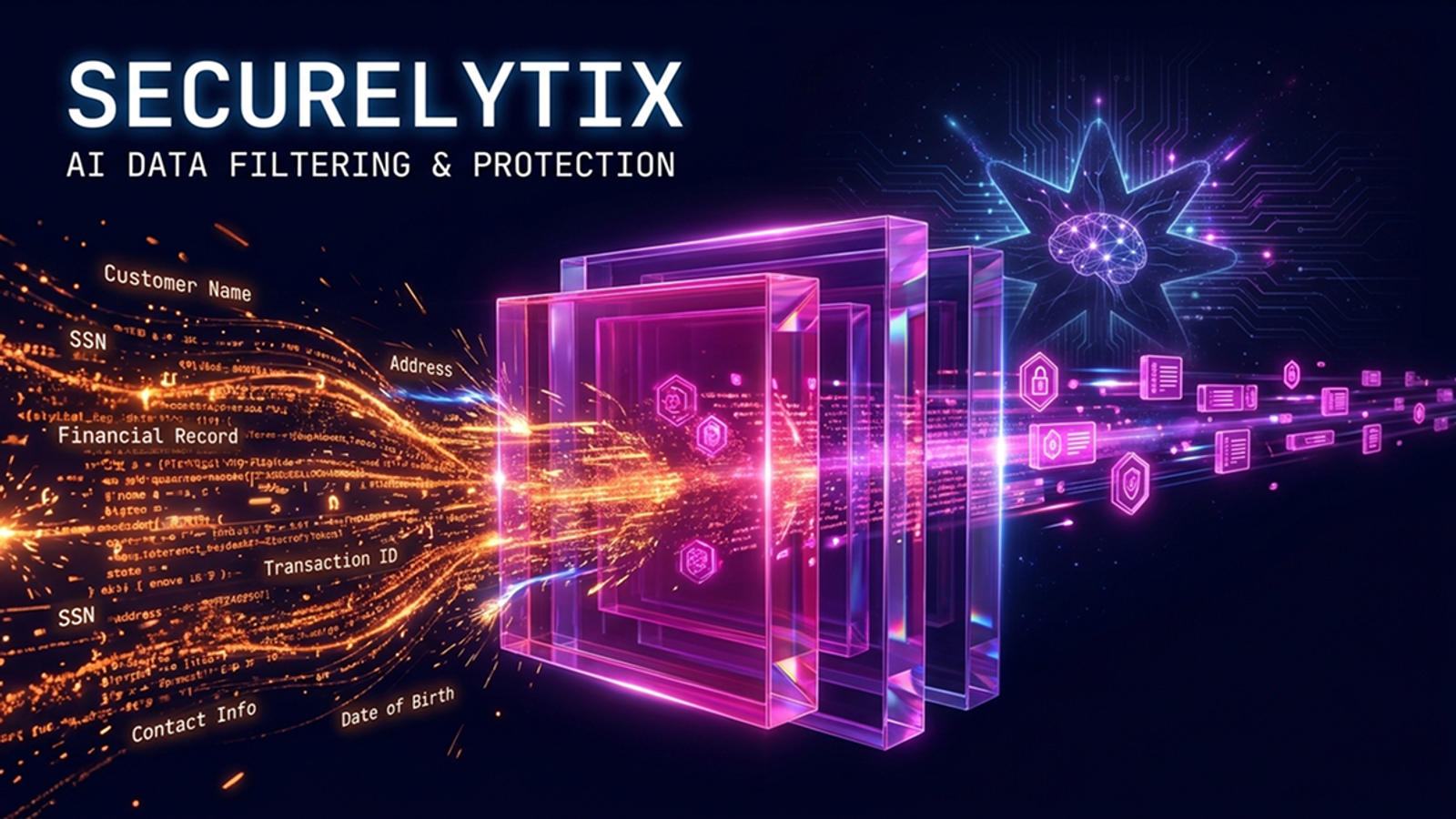
AI Is Getting Smarter. Our Data Handling Needs to Catch Up
AI is transforming how modern applications work. Customer support assistants, coding copilots, document processors, healthcare tools, financial platforms, and enterprise search are all becoming more capable with Large Language Models (LLMs).
To generate accurate responses, these models rely on context. The more relevant information they receive, the better they perform.
But here's the challenge: the same context often contains sensitive information.
Customer names, phone numbers, email addresses, payment details, government-issued IDs, healthcare records, and internal business data are frequently included in prompts sent to AI models. In many cases, applications forward this information exactly as it exists, without considering whether the model actually needs to see it.
As organizations continue to adopt AI, the conversation around security is evolving. It's no longer just about choosing a trusted model or encrypting API traffic. A more important question is emerging:
How can we ensure sensitive data never reaches the AI model unless it's absolutely necessary?
This shift represents a new way of thinking about AI security. Instead of protecting data after it has been processed, organizations are beginning to protect it before it ever leaves their applications.
That's where privacy-first AI architecture begins.
The Hidden Risk: AI Doesn't Need Every Piece of Your Data
When an application sends a prompt to an AI model, it's easy to focus on the quality of the response and overlook the data that's being shared.
Imagine a customer support assistant receiving a request like:
"Can you check the status of my refund? My name is abc, my email is abch@example.com, and my order number is ORD-45892."
The AI only needs enough context to understand the request and generate a helpful response. It doesn't need to know the customer's actual email address or full identity to explain the refund process.
The same pattern appears across industries. A healthcare assistant may receive patient details alongside medical questions. An HR copilot may process employee records while summarizing performance reviews. A financial application might include account information when generating spending insights.
In many of these cases, sensitive data is included simply because it's available not because it's required.
Once that information is sent to an external AI service, it may pass through multiple systems involved in processing the request, such as application logs, monitoring platforms, debugging tools, analytics services, or third-party integrations. Even when AI providers have strong security practices, organizations remain responsible for deciding what data should leave their environment in the first place.
This is why AI security isn't just about protecting the model it's about minimizing unnecessary data exposure.
The less sensitive information you send, the smaller your attack surface becomes, and the easier it is to meet privacy, compliance, and governance requirements.
Why Encryption Alone Isn't Enough
Encryption is a fundamental part of modern security. It protects data while it's stored and while it's being transmitted between systems. Without it, sensitive information would be exposed to anyone intercepting the communication.
But encryption has one important limitation: the AI model can't understand encrypted data.
Before an LLM can process a prompt, the data must be available in plain text. That means names, email addresses, account numbers, medical records, or other sensitive information are exposed at the moment the model reads the request.
In other words, encryption secures the journey it doesn't change what the AI ultimately receives.
This is where many organizations develop a false sense of security. They encrypt databases, secure API connections with HTTPS, and protect infrastructure, yet still send raw sensitive data directly to AI models because that's how the application was designed.
The real challenge isn't securing the connection to the model it's deciding what information should be included in the prompt in the first place.
A privacy-first AI architecture follows the principle of data minimization: only share the information that's necessary for the model to perform its task. If a piece of sensitive data doesn't improve the AI's response, it shouldn't leave your application.
By reducing the amount of sensitive information exposed to AI models, organizations lower privacy risks, simplify compliance, and maintain greater control over how customer data is handled throughout the AI workflow.
The Better Approach: Protect Data Before It Leaves Your Application
Instead of asking how to secure sensitive data after it's sent to an AI model, organizations should ask a different question:
Can we prevent sensitive data from leaving our application in the first place?
This is the idea behind privacy-first AI architecture.
Before a prompt is sent to an LLM, sensitive fields such as names, email addresses, phone numbers, government-issued IDs, payment details, or healthcare information are identified and replaced with secure, non-sensitive tokens. The AI model receives the same prompt structure and enough context to complete its task, but it never sees the original sensitive values.
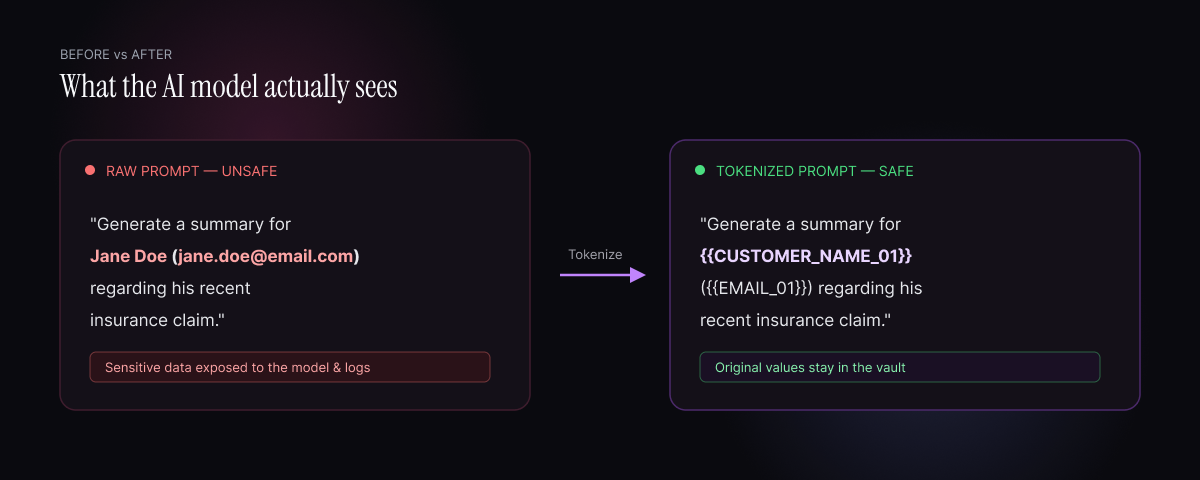
For example, instead of sending:
"Generate a summary for abc (abc@email.com) regarding his recent insurance claim."
The application sends:
"Generate a summary for {{CUSTOMER_NAME_01}} ({{EMAIL_01}}) regarding his recent insurance claim."
The AI can still summarize the claim, understand relationships between entities, and generate a high-quality response because the surrounding context remains intact. What changes is that sensitive information has been replaced with meaningless references that cannot be traced back to the original data without authorized access.
This approach is known as tokenization, and it's becoming a key building block for organizations adopting AI while maintaining strong privacy and compliance standards.
Solutions like Securelytix automate this process by tokenizing sensitive data before it reaches AI models, APIs, or third-party services. The original values remain securely stored in a protected vault, while applications continue working with tokens throughout the AI workflow. When the real data is genuinely needed, it can be retrieved through controlled authorization, with every access request logged for auditing and compliance.
The result is simple but powerful: AI continues to receive the context it needs, while sensitive data stays where it belongs under your control.
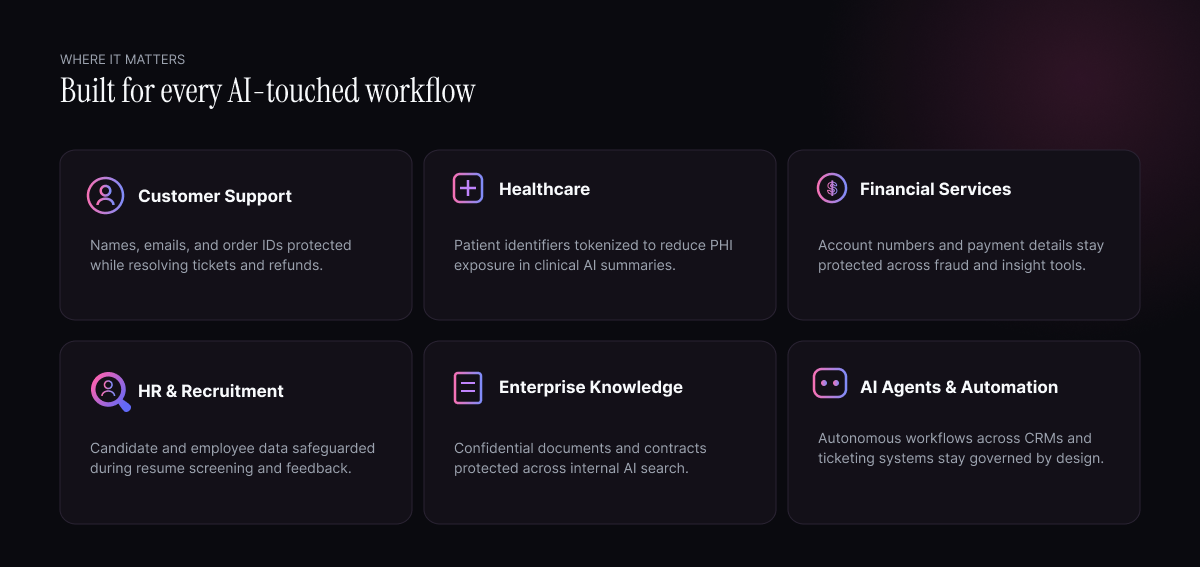
What a Privacy-First AI Workflow Looks Like
Protecting sensitive data before it reaches an AI model doesn't require rebuilding your application. Instead, it introduces a security layer that sits between your application and the AI service.
A typical workflow looks like this:
Step 1: Sensitive data enters your application.Your application receives information such as customer details, healthcare records, payment information, or other business data.
Step 2: Sensitive fields are identified.Before a prompt is created, sensitive values are detected based on predefined policies or data classifications.
Step 3: Sensitive values are tokenized.Instead of sending raw data, those values are replaced with secure, non-sensitive tokens that preserve the structure of the prompt without exposing the original information.
Step 4: The AI processes only protected data.The prompt sent to the LLM contains tokens instead of sensitive values. The model can still understand the context, reason over the request, and generate an accurate response without accessing confidential information.
Step 5: Original data is restored only when authorized.If the application needs to display the actual values to an authorized user or complete a downstream business process, the tokens are securely mapped back to the original data through controlled access. Every retrieval can be authenticated, authorized, and fully audited.
This approach significantly reduces the amount of sensitive information shared with AI models, logging systems, third-party services, and other components in the AI pipeline. Instead of trusting every system with raw data, organizations maintain control over where sensitive information is exposed and when it can be accessed.
In a privacy-first architecture, AI receives the context it needs to perform its job, while sensitive data remains protected throughout the entire workflow.
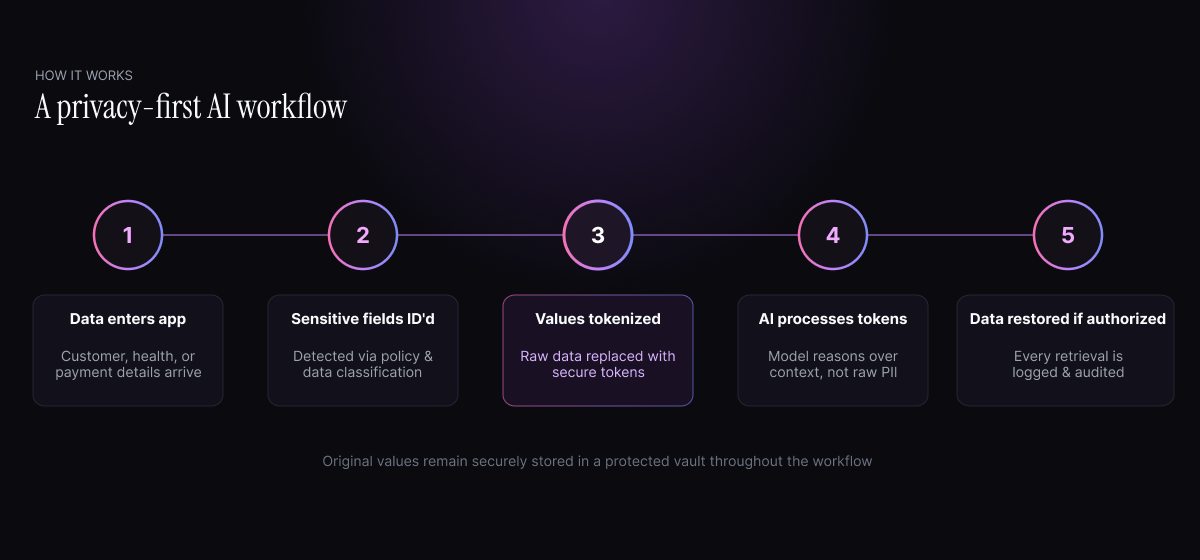
Where This Approach Makes the Biggest Difference
As AI becomes part of everyday business operations, protecting sensitive data before it reaches the model is no longer limited to highly regulated industries. Any application that processes customer or business information can benefit from a privacy-first approach.
- Customer Support Assistants
Support copilots often receive customer names, email addresses, phone numbers, order IDs, and account details to answer queries. Tokenizing this information allows the AI to understand the issue and generate helpful responses without exposing personally identifiable information (PII).
- Healthcare Applications
AI is increasingly used to summarize clinical notes, assist with documentation, and answer medical queries. By replacing patient identifiers with secure tokens, healthcare organizations can leverage AI capabilities while reducing the exposure of protected health information (PHI).
- Financial Services
Banks and fintech platforms use AI for fraud detection, customer assistance, document analysis, and financial insights. Tokenization helps protect account numbers, payment information, and customer identities while preserving the context needed for AI-driven workflows.
- HR and Recruitment Platforms
Recruiters and HR teams use AI to screen resumes, summarize employee feedback, and draft communications. Sensitive employee and candidate information can be protected without affecting the quality of AI-generated results.
- Enterprise Knowledge Assistants
Internal AI assistants often search across documents, tickets, contracts, and knowledge bases that contain confidential business information. A privacy-first approach helps ensure that sensitive company data isn't unnecessarily exposed during AI interactions.
- AI Agents and Automated Workflows
Modern AI agents don't just answer questions they interact with CRMs, databases, ticketing systems, payment platforms, and other enterprise applications. As these workflows become more autonomous, limiting the amount of sensitive data shared with AI models becomes an important layer of security and governance.
Regardless of the industry, the principle remains the same: share only the data that's necessary for the task. The less sensitive information that leaves your application, the lower the privacy risk and the greater your control over your AI ecosystem.
Security Isn't About Restricting AI. It's About Giving It the Right Data.
AI adoption is moving faster than traditional security approaches were designed for. Organizations cannot simply block AI usage or slow innovation because of privacy concerns. The goal is to build AI systems that are both powerful and responsible.
The future of AI security will not be defined by preventing applications from using data. It will be defined by controlling which data AI systems can access, when they can access it, and how that data is protected throughout the workflow.
Sending raw sensitive information directly to AI models creates unnecessary exposure. A better approach is to protect data before it leaves your application by using techniques like tokenization, access controls, and detailed audit trails.
Privacy-first AI architecture allows organizations to continue building intelligent applications while maintaining control over sensitive information. Developers can integrate AI capabilities without redesigning their entire application stack, and security teams gain better visibility into how data moves across AI workflows.
Solutions like Securelytix help organizations create this security layer by protecting sensitive data before it reaches AI models, APIs, and external services. By keeping real data protected and exposing only what is necessary, businesses can adopt AI confidently without compromising privacy.
The safest AI systems are not the ones that avoid data—they are the ones that know exactly how to protect it.
Final Thought
The question for modern AI applications is no longer:
"Can we use AI with sensitive data?"
The better question is:
"How can we use AI while ensuring sensitive data never becomes an unnecessary risk?"
Frequently Asked Questions
Why shouldn't I send sensitive data directly to AI models?
Most AI tasks don't require raw personal or confidential information to generate accurate responses. Sending unnecessary PII or sensitive business data increases privacy risks, expands your attack surface, and can create compliance challenges. A privacy-first approach ensures only the data required for the task reaches the AI model.
Isn't encryption enough to protect AI prompts?
No. Encryption protects data while it's stored or transmitted, but the AI model must receive plaintext data to process a prompt. This means sensitive information is still exposed during inference. Tokenization helps solve this by replacing sensitive values with secure tokens before the prompt reaches the model.
How does tokenization improve AI security?
Tokenization replaces sensitive information—such as names, email addresses, payment details, or healthcare records—with non-sensitive tokens before data is sent to an AI model. The original values remain securely stored in a protected vault and can only be restored through authorized, audited access, reducing privacy risks without impacting AI performance.
Ready to Secure Sensitive Data?
Explore how Securelytix helps teams protect sensitive data, enforce privacy controls, and build Secure AI deployment.