
Inside a Modern Token Vault: How Sensitive Data Stays Protected
Securelytix Team
Product & Security
29 July 2026
As modern applications move sensitive data across APIs, microservices, third-party platforms, and AI systems, traditional security controls are no longer enough. A modern token vault protects sensitive information by replacing raw data with secure tokens while keeping original values protected inside an isolated environment. This article explores how token vault architecture works, from sensitive data detection and token generation to secure storage, controlled detokenization, and privacy-focused analytics.
Introduction
Every modern application processes sensitive information. Customer names, email addresses, phone numbers, payment details, healthcare records, and government-issued identifiers flow through APIs, microservices, AI models, analytics platforms, and logging systems every second. While this data powers personalized experiences and business operations, it also increases the risk of accidental exposure.
Most organizations invest heavily in securing databases, encrypting storage, and protecting network traffic. Those controls are essential, but they address only part of the problem. Sensitive data rarely stays inside a database. It moves continuously between applications, third-party services, observability platforms, and increasingly, AI systems. Every movement creates another opportunity for that data to be copied, logged, cached, or exposed.
This is where a token vault changes the security model.
Instead of allowing raw sensitive information to travel across every system, a token vault replaces it with safe, meaningless tokens before the data leaves the application. The original values remain securely protected inside the vault and are restored only when an authorized operation genuinely requires them. The result is a significant reduction in the amount of sensitive data circulating through the environment, without forcing developers to redesign existing workflows.
Modern token vaults go beyond simple token generation. They detect sensitive information, securely manage token-to-value mappings, enforce controlled detokenization, and provide visibility into protection activity through telemetry and customer-specific analytics. This combination allows organizations to strengthen privacy, simplify compliance, and maintain operational confidence while preserving application performance.
In this article, we'll explore the architecture of a modern token vault, examine how it protects sensitive data throughout its lifecycle, and look at the core design principles that make it suitable for today's API-driven and AI-powered applications.
Why Traditional Security Isn't Enough
Most organizations already have strong security foundations in place:
- Database encryption
- TLS for data in transit
- Identity and Access Management (IAM)
- Secret management solutions
These controls are critical but they weren't designed to protect sensitive data while it's moving through applications.
Modern applications process data across dozens of services before a request is complete. A single API call might pass through an API gateway, multiple microservices, logging systems, analytics platforms, third-party APIs, and even AI models.
At every step, sensitive information has another opportunity to be copied, cached, or logged.
Consider a simple customer registration request.
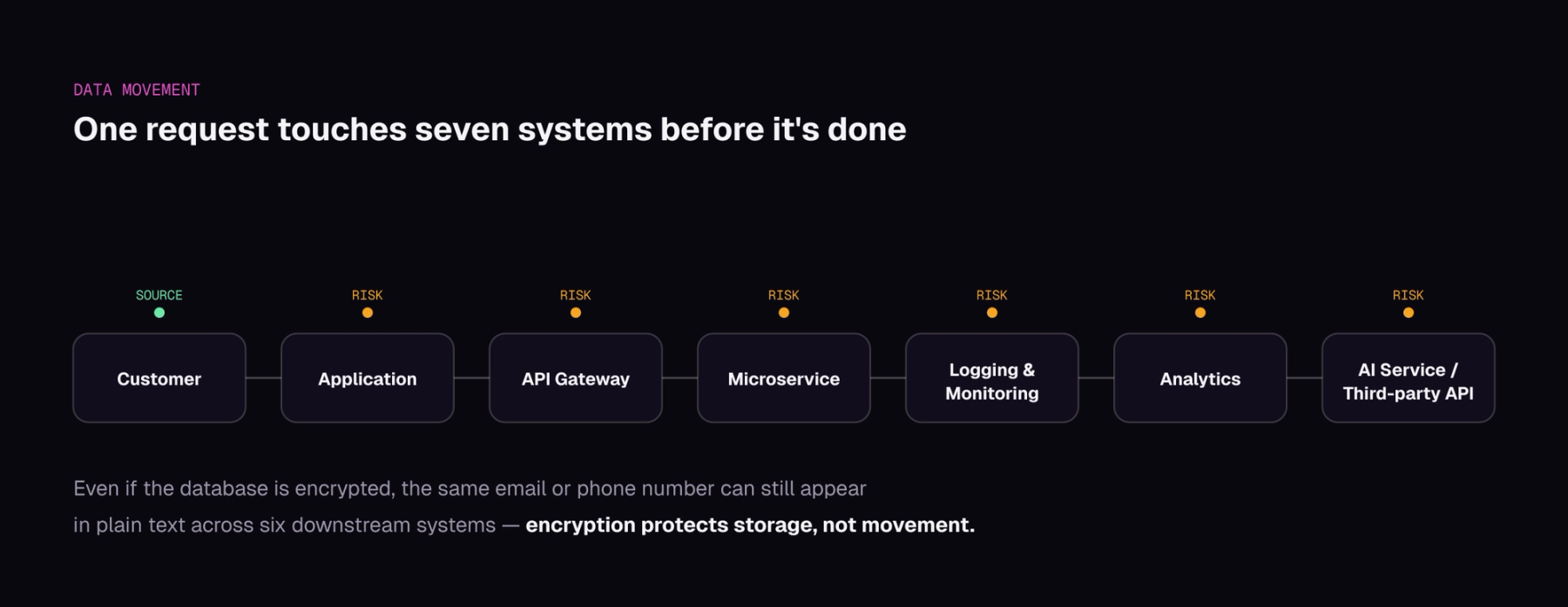
Even if the customer database is encrypted, the same email address or phone number may still appear across multiple downstream systems in plain text.
That's because encryption protects stored data, not the information being actively processed by applications.
The challenge isn't weak encryption it's data movement.
Once an application decrypts data for legitimate use, traditional security controls have limited visibility into where that information travels next. Debug logs, observability tools, AI prompts, and external integrations can all become unintended exposure points.
A modern token vault addresses this problem differently.
Instead of allowing raw sensitive values to flow through every service, it detects sensitive fields and replaces them with secure tokens before the request continues downstream. The original values remain protected inside the vault, while applications continue operating on tokens that have no usable meaning outside the vault.
What Is a Modern Token Vault?
A token vault is a security layer that sits between your application and the systems that process sensitive data. Instead of allowing personally identifiable information (PII) or protected health information (PHI) to travel through every service, the vault replaces sensitive values with unique, meaningless tokens. The original data is securely stored inside the vault and can only be restored when an authorized request is made.
Unlike traditional encryption, which still requires applications to decrypt data before using it, tokenization minimizes the exposure of sensitive information throughout the application lifecycle. Most services continue to operate on tokens, significantly reducing the risk of data leakage.
At a high level, the workflow looks like this:
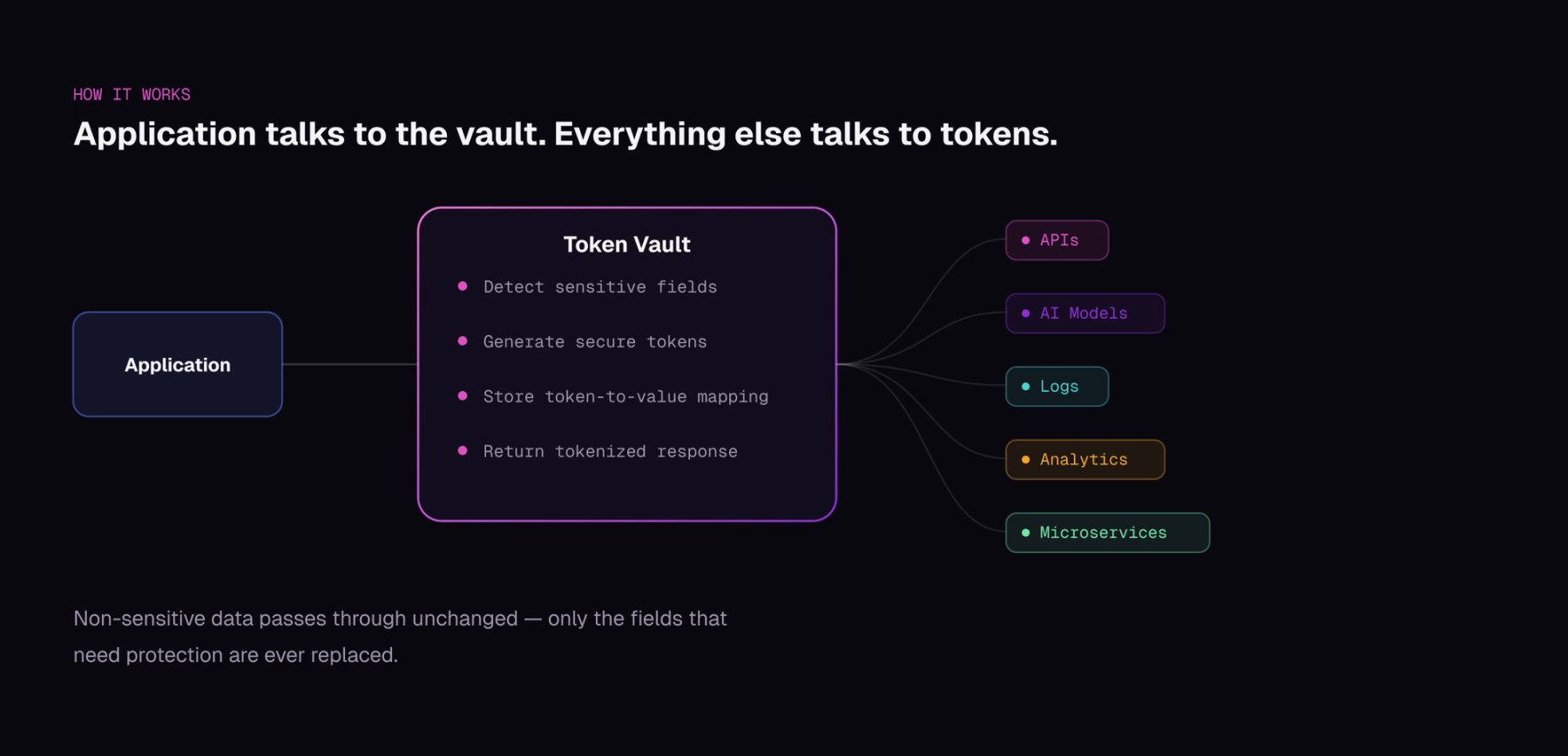
When the application receives customer data, it sends the request through the token vault. The vault identifies sensitive fields such as email addresses, phone numbers, names, or other regulated data and replaces only those values with secure tokens. Non-sensitive data remains unchanged, allowing applications to continue functioning without major changes.
When an application genuinely needs the original value for example, to send an email or verify a customer's identity it makes an authorized detokenization request. The vault validates the request, restores the original value, and records the operation for auditing.
A modern token vault does more than tokenization
Production-ready token vaults are designed to provide much more than simple value replacement. They typically include:
- Sensitive data detection to identify PII and PHI before processing.
- Secure token generation that produces unique, non-reversible tokens.
- Encrypted mapping storage for safely maintaining token-to-value relationships.
- Policy-based detokenization so original values are restored only when authorized.
- Telemetry and analytics to provide visibility into tokenization activity, vault health, and usage trends.
By reducing the amount of raw sensitive data moving across applications, APIs, AI services, and operational tools, a token vault helps organizations strengthen privacy without disrupting existing development workflows.
Inside the Architecture of a Modern Token Vault
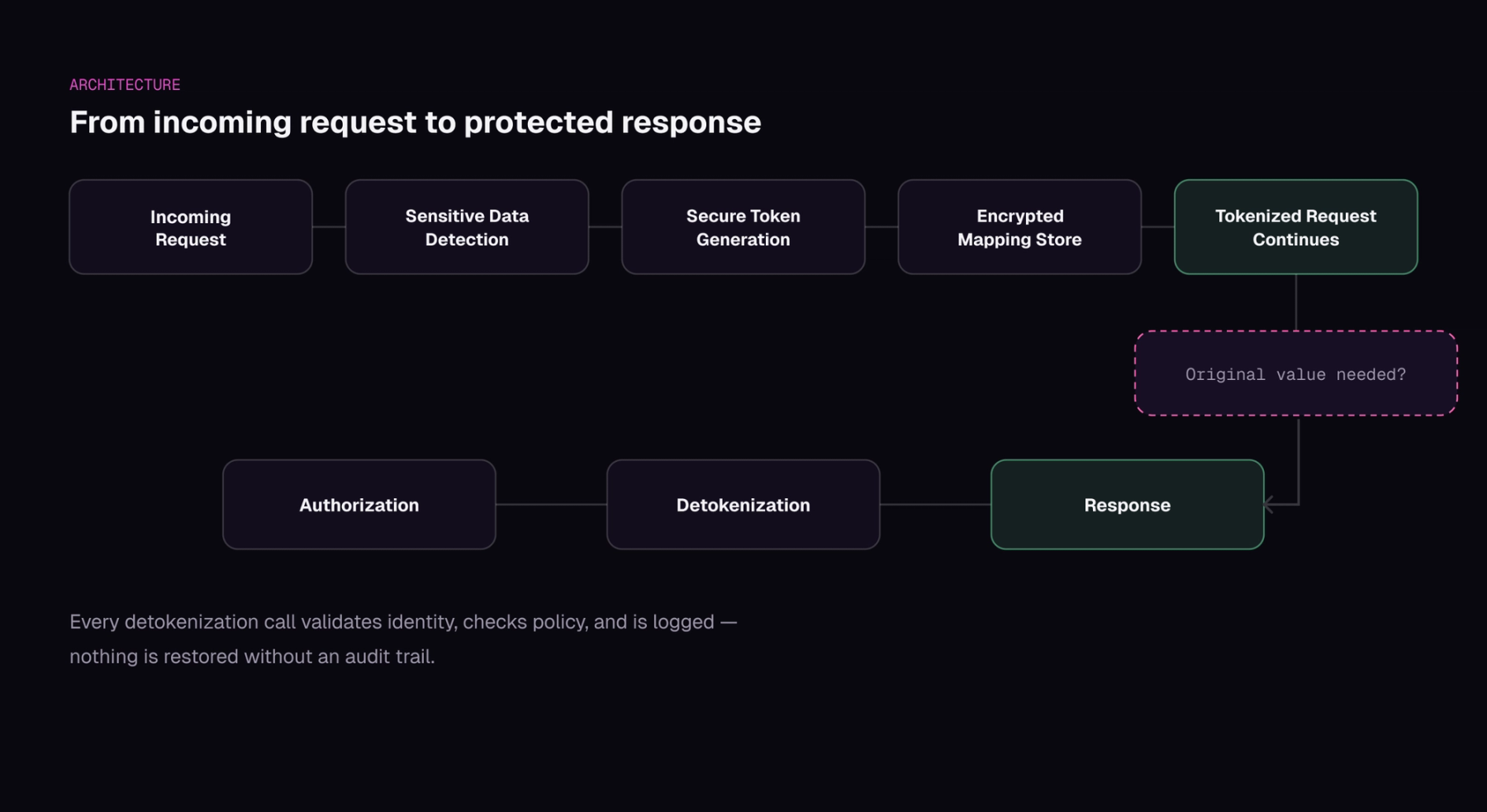
A modern token vault does much more than replace sensitive values with tokens. It detects sensitive information, generates secure tokens, stores the mapping safely, and restores the original value only after authorization.
The overall workflow looks like this:
1. Detecting Sensitive Data
The first step is identifying which fields actually require protection.
Rather than tokenizing an entire payload, the vault detects sensitive information such as email addresses, phone numbers, names, payment details, and other regulated data. Non-sensitive fields remain unchanged, allowing applications to continue processing requests without unnecessary overhead. This selective approach improves performance while ensuring only sensitive values are protected.
2. Generating Secure Tokens
Once sensitive fields are identified, they're replaced with secure tokens.
For example:
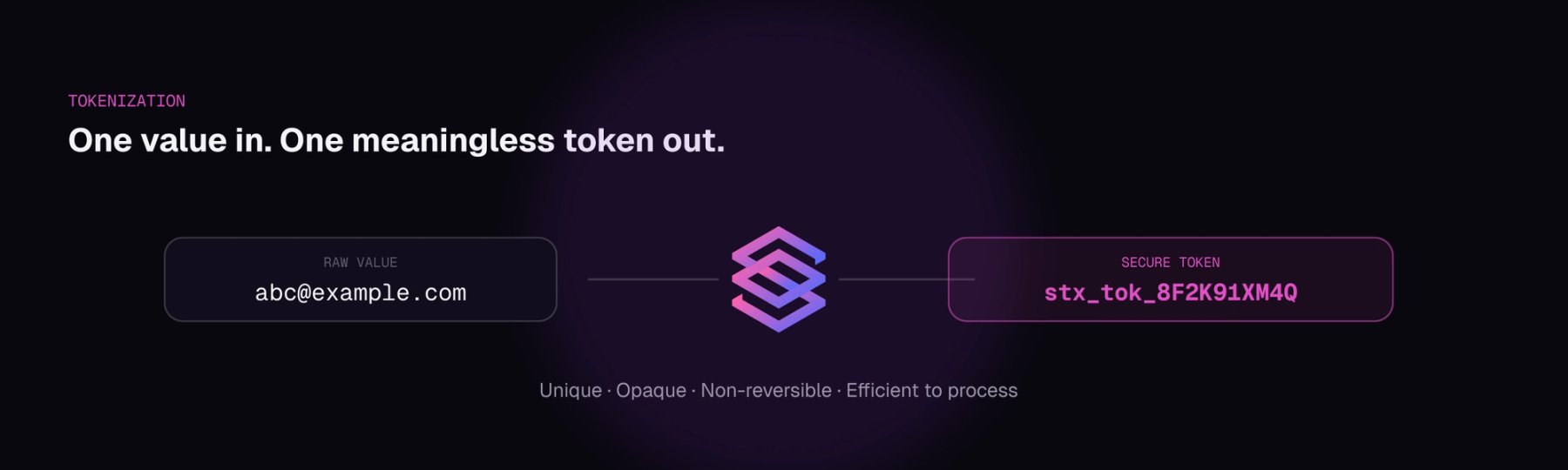
Applications, APIs, AI models, and downstream services now work with the token instead of the original value.
A secure token should be:
- Unique
- Opaque
- Non-reversible
- Efficient to process
The vault also stores a secure mapping between the token and its original value, ensuring the data can be restored only when required.
3. Secure Storage and Tenant Isolation
The mapping between a token and its original value is the foundation of the vault.
Along with the original value, the vault securely maintains metadata such as the data type, tenant ID, creation time, and access policies. This enables policy enforcement while keeping sensitive information isolated from downstream systems.
For enterprise environments, tenant isolation is equally important. Every customer's mappings remain private to their workspace, ensuring one tenant can never access another tenant's protected data or analytics.
4. Controlled Detokenization
There are legitimate situations where applications need the original value, such as sending emails, processing payments, or verifying a customer's identity.
Instead of directly accessing stored mappings, applications send a detokenization request to the vault.
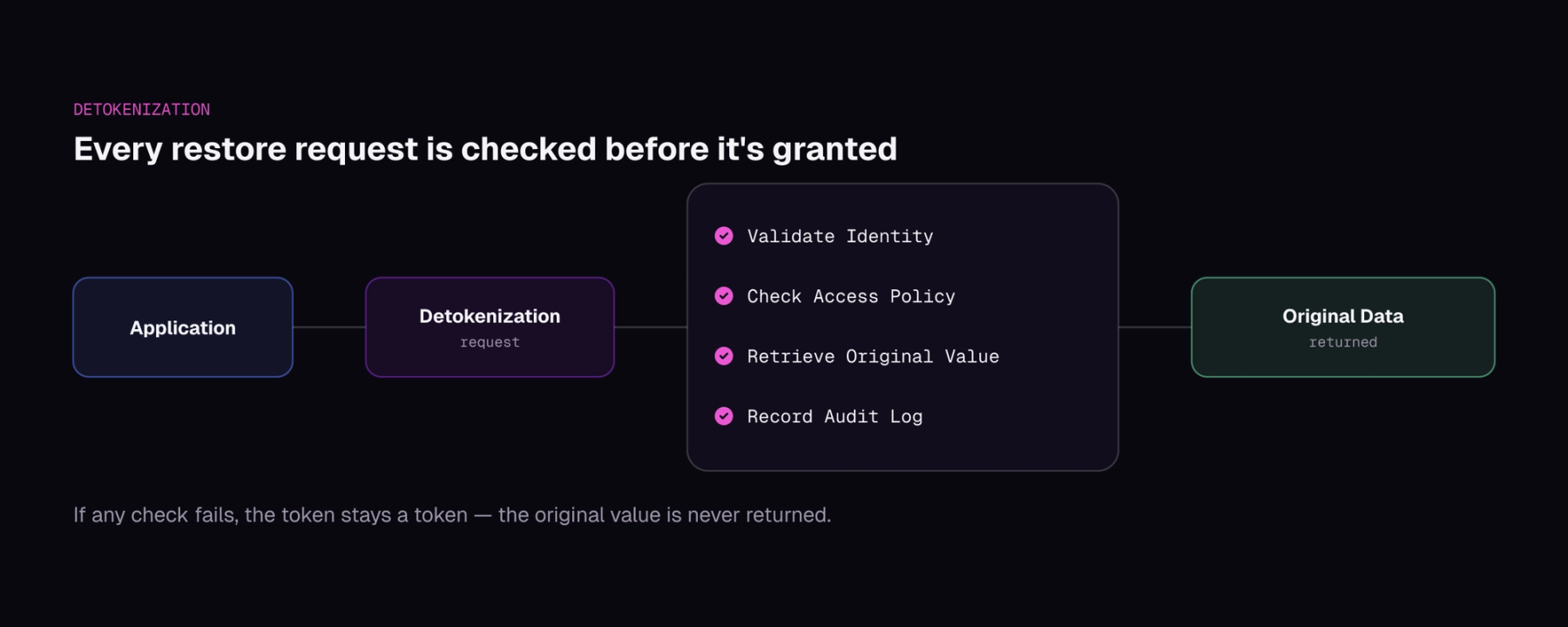
Before returning the original value, the vault verifies the caller's identity, validates permissions, and enforces security policies. Every operation is recorded, providing a complete audit trail of who accessed sensitive data and when. This minimizes unnecessary exposure while allowing authorized business processes to continue securely.
Beyond Protection: Visibility That Builds Trust
A token vault shouldn't operate as a black box. Protecting sensitive data is important, but organizations also need to understand what is being protected and how their protection layer is performing.
Every tokenization and detokenization request generates operational telemetry that can be used to measure protection activity without exposing the underlying data. Instead of relying solely on infrastructure logs, engineering and security teams gain insights into how sensitive information flows through their applications.
Some of the most valuable operational metrics include:
- Total tokenization and detokenization requests
- Number of sensitive fields protected
- PII and PHI breakdown by data type
- API usage trends
- Vault health and recent activity
These insights help teams answer questions like:
- Is the vault actively protecting requests?
- Which types of sensitive data appear most frequently?
- Is application traffic increasing?
- Are we approaching usage limits?
Because these metrics are generated from vault activity rather than raw customer data, organizations gain visibility without compromising privacy. Each customer views only their own workspace, ensuring complete tenant isolation across analytics and operational dashboards.
Final Thoughts
As applications become more distributed and AI-driven, sensitive data is no longer confined to databases. It moves continuously through APIs, microservices, third-party integrations, observability platforms, and AI services. Protecting data only at rest is no longer enough.
A modern token vault addresses this challenge by minimizing where sensitive information exists in plain text. Through intelligent detection, secure tokenization, protected mapping storage, controlled detokenization, and operational visibility, organizations can reduce data exposure without disrupting existing application workflows.
At Securelytix, this approach is delivered through a lightweight token vault that runs alongside customer applications, protecting sensitive data before it reaches downstream systems while providing private analytics that demonstrate how that protection is working. The result is a security model that strengthens privacy, supports compliance, and gives engineering teams the confidence to build modern applications without exposing the data that matters most.
Frequently Asked Questions
What is a token vault and how does it protect sensitive data?
A token vault is a security layer that replaces sensitive information such as PII, payment details, and healthcare data with secure, meaningless tokens. The original values remain protected inside the vault and are only restored through authorized detokenization requests.
How is tokenization different from encryption?
Encryption protects data by converting it into an unreadable format that can be decrypted with a key. Tokenization reduces exposure by replacing sensitive values with non-sensitive tokens, allowing applications, APIs, and AI systems to operate without accessing the original data.
Why do AI applications need a token vault?
AI applications often process sensitive information through prompts, APIs, logs, and external model providers. A token vault prevents raw sensitive data from entering AI workflows by replacing it with secure tokens, reducing the risk of data leakage while allowing AI systems to function normally.
Ready to Secure Sensitive Data?
Explore how Securelytix helps teams protect sensitive data, enforce privacy controls, and build Secure AI deployment.