


Lawful processing
Personal data must be processed in accordance with applicable legal requirements.
DPDP Act, 2023 & AI workflows
Protect personal data before it reaches AI models, APIs, and external systems.
As businesses adopt AI, personal data moves across more applications, tools, and services. Securelytix helps you protect sensitive information with tokenization, secure data vaulting, and controlled data restoration.
Customer record in your app

Tokenizing
Prompt the model receives
Hi, I'm Mqrvte Lio_stx. My number is +91 47218 90563_stx and order #48213 hasn't arrived.
Please email updates to qmvbtl@xkpwqhd.in_stx
The model receives tokens only. Originals stay in the vault.
Vaultkey Core v3.2.0 · Deterministic Latency < 1.2ms









Every time a user signs up, makes a payment, or interacts with an AI application, personal data may be collected and processed.
The Digital Personal Data Protection (DPDP) Act, 2023 establishes a legal framework for processing digital personal data in India. It defines responsibilities for organisations and recognises rights and duties related to individuals.
As AI adoption grows, sensitive data can move through AI prompts, agent tools, APIs, logs, vector databases, and third-party services.
This creates a practical challenge for businesses:
How do you protect personal data throughout the AI workflow, not just where it is stored?
DPDP and AI security go hand in hand. Building responsible AI applications means understanding where personal data flows, who can access it, and how unnecessary exposure can be reduced.
The DPDP Act is India's legal framework for protecting digital personal data. It establishes responsibilities for organisations processing personal data and provides rights and duties related to individuals. For businesses building AI applications, DPDP highlights the importance of responsible data processing, security safeguards, and appropriate data protection practices.
Personal data must be processed in accordance with applicable legal requirements.

Organisations must provide appropriate information and obtain consent where required, subject to applicable provisions and exceptions.

Organisations must implement applicable safeguards to protect personal data.

The framework provides rights for individuals, subject to the Act and applicable provisions.

Organisations need processes to manage their data protection responsibilities.
For developers
DPDP is not only a legal or compliance task. It also affects how applications are designed.
Developers need to consider where personal data is stored, which systems can access it, and whether every downstream service needs the original value.
Security controls such as encryption, access controls, logging, and tokenization can form part of a broader data protection strategy.
Modern applications rely on multiple services to deliver a single user experience.
A customer may submit information through your application, which then sends data to APIs, databases, AI models, or external tools. Each step can introduce another point where personal data is processed or exposed.
A customer shares their name, phone number, and order details. The AI assistant accesses an order management API and generates a response.
Along the way, personal data may pass through multiple systems. The original value may not be necessary at every step.
Which systems need the original data, and which can work with a protected representation instead?
Understanding this flow is the first step towards reducing unnecessary exposure and applying the right security controls.
Application
Data enters
APIs
Database
Tools
AI agent
Analytics
Third-party services
Each system may process personal data.
AI applications can access information, call tools, and complete tasks on behalf of users. But as applications become more capable, controlling the data they share becomes increasingly important.
Personal data that was once handled within your application may now be passed to AI models, external APIs, and other services.
// prompt
user: Hi, I'm Ananya Rao
call me on +91 98765 43210
Raw personal data may be included in prompts sent to an AI model.
POST /tools/order_lookup
{ "customer": Ananya Rao
  "email": ananya@example.in }
AI agents may share customer information with APIs or tools while completing a task.
12:04:11 INFO order.fetch ok
12:04:11 DEBUG payload=
+91 98765 43210
12:04:12 WARN retry email= ananya@…
Sensitive values can unintentionally appear in application logs, debugging output, and observability systems.
Personal data may enter retrieval workflows and become available to downstream components.
Applications may send information to external providers for processing or other business functions.
The challenge
Encryption at rest does not automatically control every place an application sends a value after reading it. That's why security needs to extend beyond storage and into the application's runtime.
Ask not only, "Is the data encrypted?" but also, "Does this system need the original value?"
Securelytix helps teams build data protection into the way their applications handle sensitive information.
With Vaultkey, sensitive values can be tokenized and stored in a secure vault, allowing supported workflows to use tokens instead of exposing original values unnecessarily.

Identify the sensitive data that needs protection.
Understand which values are handled by your applications and where they may be passed to AI models, APIs, or external services.
Mqrvte Lio_stx
original in vault

Replace sensitive values with secure tokens.
Vaultkey is designed to keep original values in a secure vault while a token is created in its place. Supported workflows work with tokenized representations.

Control when original values can be restored.
Apply appropriate authorization and runtime controls to manage detokenization requests for permitted operations.

Maintain visibility into sensitive data operations.
Use relevant activity records and audit information, where supported, to help teams monitor and review sensitive data operations.
Protect the data before it moves. Control access when it matters.
The goal is simple: use the data your application needs without exposing original sensitive values to every system in the workflow.
Vaultkey uses tokenization and vaulting to help separate sensitive values from the data that downstream systems process.
PII
+91 98765 …
Securelytix Vaultkey
Tokenize and vault
Token
+91 47218 90563_stx
AI / API / Tool
Works with token
Authorised recovery
When permitted
Your application receives information such as a name, email address, phone number, or other sensitive value.
The original value is stored in a secure vault while a token is created in its place.
The token can be used in supported AI workflows, APIs, or other downstream systems without sending the original value unnecessarily.
When an authorised operation requires the original value, the application can request detokenization according to the applicable controls and permissions.
Detokenization activity can be logged to support oversight and investigation.
DPDP compliance involves more than a single security product. It requires organisations to address applicable legal, organisational, and technical responsibilities.
Securelytix can support parts of this work by helping teams protect personal data as it moves through applications and services.
DPDP consideration
Securelytix control
Protect personal data
Use tokens in supported downstream workflows
Reduce unnecessary data exposure
Authorised detokenization and applicable access controls
Control access to sensitive information
Relevant access and detokenization activity records
Maintain operational visibility
Tokenization and secure vaulting
DPDP establishes responsibilities around personal data processing and protection. Securelytix provides technical capabilities that may support some of those responsibilities.
Protecting personal data starts with building the right controls into your application architecture.
The controls you need depend on your architecture, the data you process, your legal obligations, and your implementation.
Encryption and tokenization are both used to protect sensitive data, but they work differently. Understanding the difference helps developers choose the right controls for their applications.

Encryption transforms data into a protected form using a cryptographic process. The original data can be recovered through the appropriate decryption mechanism.
Encryption is commonly used to protect data at rest and in transit.

Tokenization replaces a sensitive value with a token that represents it within a supported system.
The original value is stored separately, typically in a secure vault, and can be retrieved through an authorised process.
When an application sends data to an AI model or external service, encryption alone may not solve the problem of exposing the original value to the receiving system after the data is decrypted for processing.
Tokenization can help reduce that exposure by allowing supported workflows to use tokens instead of original values.
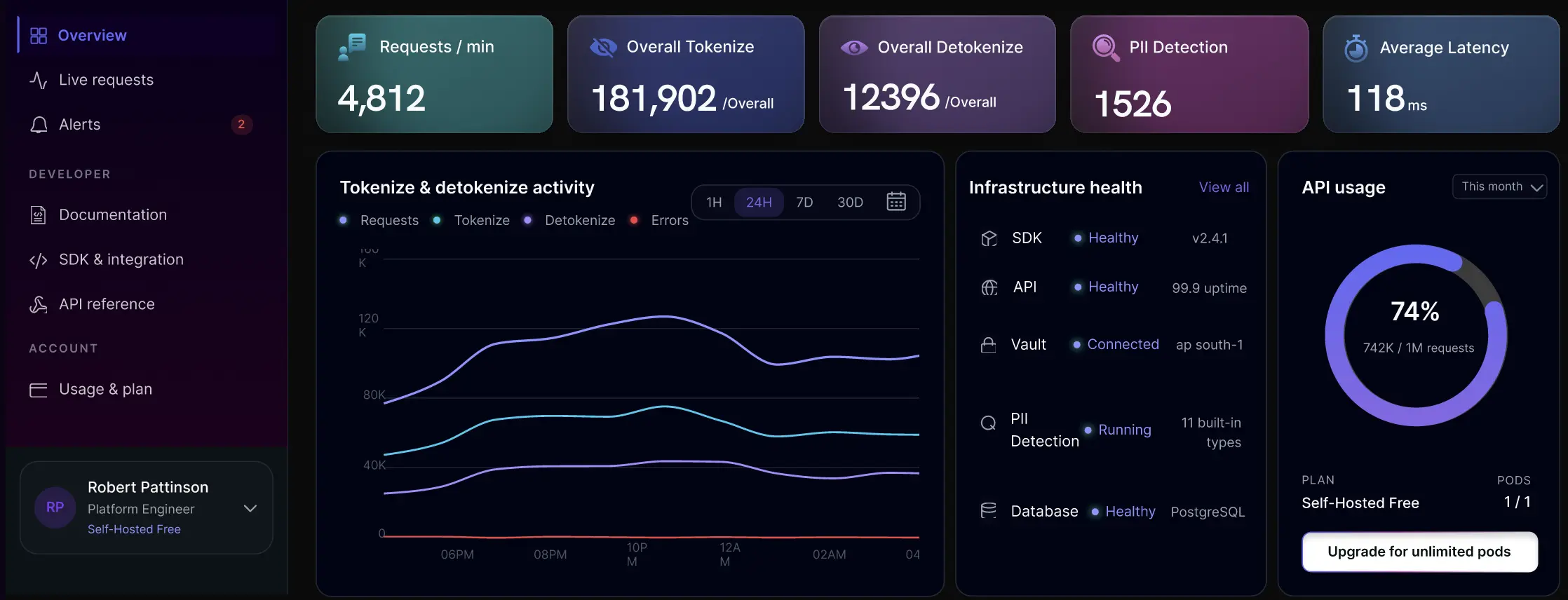
Understanding the architecture is useful. Seeing the product work makes the approach easier to evaluate.
Explore how Securelytix Vaultkey helps developers protect sensitive data through tokenization, secure vaulting, and controlled data restoration.
Tokenization
See how a sensitive value is replaced with a token.

Integration
Understand how an application connects with Vaultkey through the supported API workflow.
Protected processing
See how a token can be used in a supported downstream workflow without unnecessarily exposing the original value.

Controlled detokenization
Understand how an authorised request can restore the original value.

Operational visibility
Explore available activity records or audit-related information that helps teams understand sensitive data operations.
Python · illustrative example
tokenize, then send
# 1. Tokenize before the value leaves your appfrom securelytix import Vaultkeyvault = Vaultkey(api_key="SECURELYTIX_KEY")phone = vault.tokenize(field="phone",value="+91 98765 43210",)# phone -> "+91 47218 90563_stx"# 2. The model works with the tokenreply = llm.chat(messages=[{"role": "user","content": f"Update {phone}"}])# 3. Restore only when an authorised# operation needs the original valueoriginal = vault.detokenize(token=phone,purpose="send_sms",)
FAQ
Personal data is moving through more systems than ever. Protecting it starts with understanding where it goes and controlling when original values are exposed.
Securelytix Vaultkey helps you build data protection into your AI and application workflows with tokenization, secure vaulting, and controlled data restoration. Ready to explore how it fits your architecture?
Talk to our team about protecting sensitive data across your AI applications, APIs, and enterprise workflows.